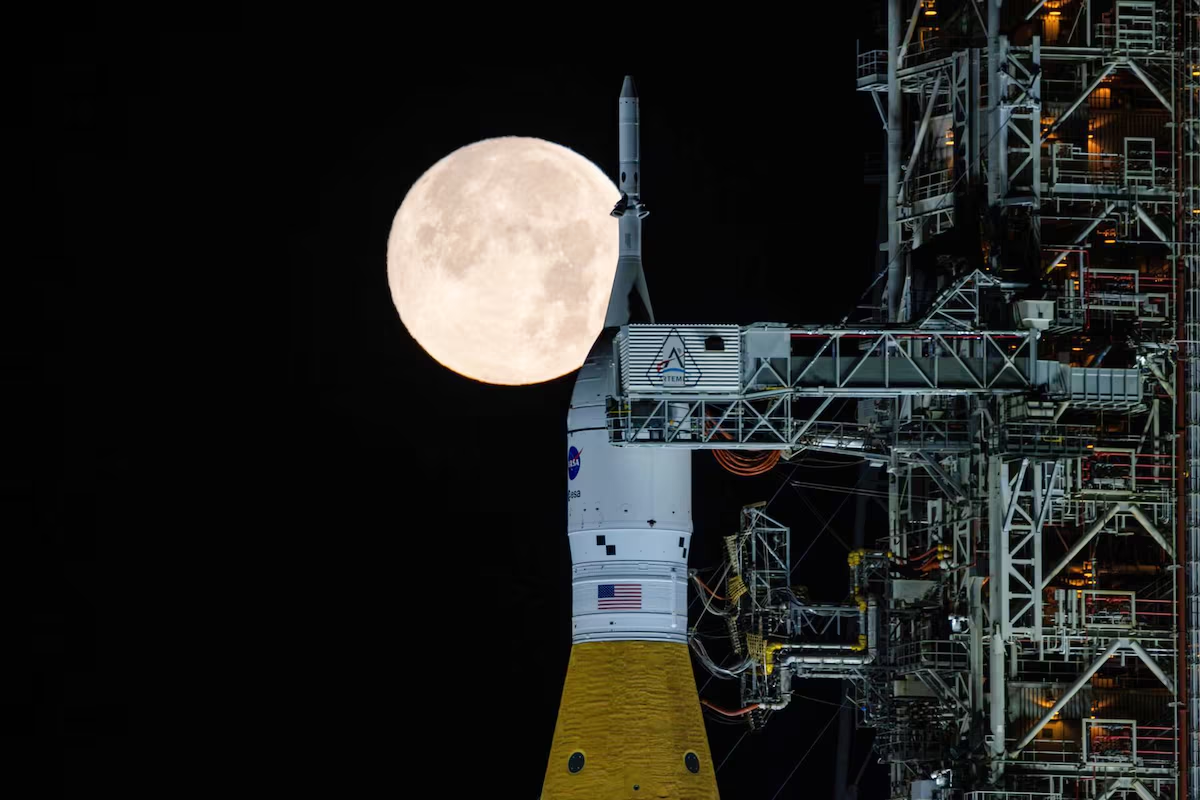
NASA’s SLS rocket and Orion spacecraft stood ready at the Kennedy Space Center in Florida on Sunday. The Associated Press
A key test for NASA’s next moon mission ran into trouble Monday after fuel leaks forced engineers to pause a critical countdown rehearsal. The issue raised fresh questions about how soon astronauts can begin their long-awaited journey around the moon.
Leak Appears Early in Critical Test
The problem emerged only hours into a full-day practice countdown at Kennedy Space Center. Teams had started loading the massive Artemis rocket with super-cold liquid hydrogen and oxygen shortly before noon.
More than 2.6 million litres of fuel needed to flow into the rocket and remain there for several hours. The process aimed to mirror the final stages of a real launch countdown. Soon after fuelling began, engineers noticed hydrogen building up near the lower section of the rocket.
Fuelling Paused Multiple Times
Launch controllers halted hydrogen loading at least twice as they worked to control the leak. Engineers relied on techniques developed during earlier tests, including those used in 2022, when similar leaks delayed the rocket’s first uncrewed flight.
Despite those earlier challenges, the rocket eventually launched successfully without astronauts. Monday’s issue showed that fuel handling remains one of the program’s biggest hurdles.
Astronauts Watch From Houston
The four astronauts assigned to the mission followed the test closely from Houston, about 1,600 kilometres away. Three are American, and one is Canadian. The crew has remained in quarantine for more than a week as they await final launch preparations at Johnson Space Center.
The test will help determine whether NASA can move forward with the mission on schedule.
Launch Window Remains Tight
If everything falls into place, NASA could launch the mission as early as Sunday. However, officials said the rocket must lift off by February 11 or wait until March. Launch opportunities remain limited to only a few days each month.
Cold weather has already shortened February’s launch window, leaving little room for delays.
Countdown Practice Still Underway
Despite frigid temperatures, teams began the rehearsal Saturday night. The test allowed controllers to practise each step of the countdown and address any remaining technical issues. The clocks will stop just seconds before ignition, ending the exercise before engines fire.
The rehearsal remains a vital step before committing astronauts to flight.
Mission Aims and Long-Term Goals
The nearly 10-day Artemis II mission will send the crew past the moon, around its far side, and back to Earth. Astronauts will test the spacecraft’s life-support systems and other key equipment. The mission will not enter lunar orbit or attempt a landing.
NASA last sent astronauts to the moon during the Apollo era in the 1960s and 1970s. The Artemis program aims to build a long-term human presence there. Commander Reid Wiseman and his crew will help lay the groundwork for future moon landings.