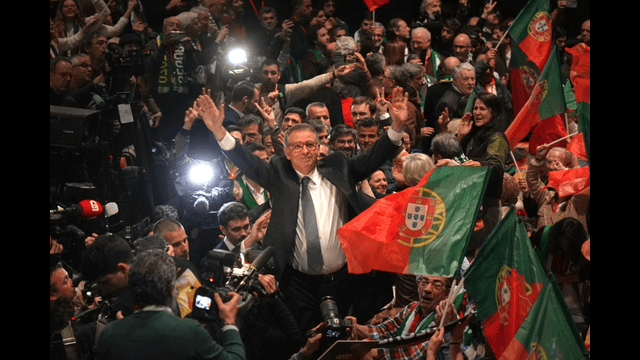
Center-left Socialist candidate António José Seguro celebrates after defeating far-right populist André Ventura in the second round of Portugal’s presidential election in Lisbon, Sunday, Feb. 8, 2026.
Portugal’s presidential runoff has delivered a decisive verdict, signaling voter preference for stability over confrontation.
Center-left candidate António José Seguro secured a commanding victory against hard-right populist André Ventura.
With almost all ballots counted, the outcome left little room for doubt or dispute.
Seguro captured 66.7 percent of the vote.
Ventura finished with 33.3 percent.
The margin reflected a strong rejection of populist politics at the highest symbolic office.
The Portuguese presidential runoff became more than a routine election.
It served as a measure of public tolerance for Europe’s growing rightward political shift.
It also tested whether Ventura’s confrontational style could translate into national leadership.
A Vote for Moderation and Cooperation
Throughout the campaign, Seguro positioned himself as a steady and pragmatic choice.
He emphasized dialogue, institutional balance, and cooperation with Portugal’s minority government.
That approach resonated with voters weary of prolonged political turbulence.
Seguro is a long-established figure within the Socialist Party.
He appealed to both center-left supporters and moderate conservatives.
Several mainstream leaders publicly endorsed him to counter rising populism.
European Commission President Ursula von der Leyen quickly welcomed the result.
She said Portugal’s commitment to shared European values remained firm.
Her message underscored the broader continental significance of the vote.
The Role of Portugal’s President
Portugal’s presidency carries limited executive authority.
The office is designed to stand above daily partisan disputes.
Still, the role carries substantial political influence.
The president can veto parliamentary legislation.
Although parliament can override that veto, it often forces compromise.
More dramatically, the president can dissolve parliament and call early elections.
That power has taken on greater importance recently.
Portugal has held three general elections in just three years.
Political instability has strained public confidence and governance.
Steady leadership will be a central challenge for Seguro’s term.
His supporters argue his calm style suits the moment.
They believe moderation can help ease institutional tensions.
Ventura’s Populist Challenge
André Ventura acknowledged defeat but showed no signs of retreat.
He described his campaign as part of a longer political transformation.
Ventura promised to continue challenging Portugal’s political establishment.
Reaching the Portuguese presidential runoff itself marked a milestone for him.
His Chega party was founded less than seven years ago.
Yet it has already reshaped the national political landscape.
Chega emerged as the second-largest party in parliament during May’s general election.
That rise reflects voter frustration with traditional parties.
It also highlights anxiety around social and economic change.
Immigration at the Center of Debate
Immigration became a defining issue during the campaign.
Ventura framed foreign workers as a threat to national identity.
His rhetoric often drew sharp criticism from opponents.
Campaign billboards carried provocative slogans.
They included messages opposing welfare access for immigrants.
Critics said the language deepened social divisions.
Seguro rejected that framing outright.
He emphasized inclusion, legality, and social cohesion.
That contrast helped clarify the stakes for undecided voters.
What Comes Next for Portugal
Seguro will assume office next month.
He replaces outgoing President Marcelo Rebelo de Sousa.
The incumbent has reached the constitutional two-term limit.
The transition comes at a sensitive time.
Economic pressures and political fragmentation remain unresolved.
Public expectations for stability are high.
The Portuguese presidential runoff has delivered a clear message.
Voters favored consensus over confrontation.
Whether that choice brings lasting stability will shape Portugal’s political future.