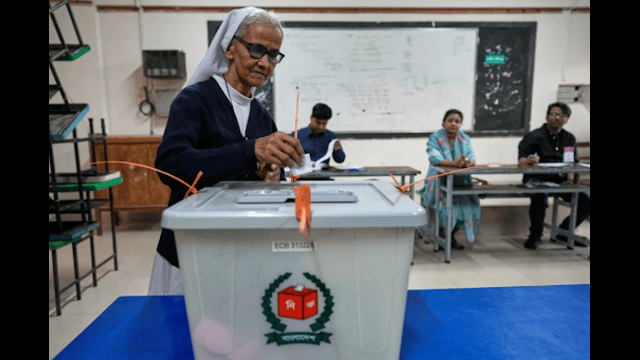
A Bangladeshi Christian nun casts her vote in a polling station during national parliamentary election in Dhaka, Bangladesh, Thursday, Feb. 12, 2026.
Bangladesh went to the polls on Thursday in a landmark parliamentary election.
The vote is widely seen as a defining moment for the country’s fragile democracy.
It is the first national election since the 2024 Gen Z uprising reshaped Bangladesh’s political landscape.
Polling began slowly in the morning hours.
By midmorning, voter turnout picked up across Dhaka and other major cities.
Election officials said voting would continue through the day, with results expected Friday.
More than 127 million citizens are eligible to participate.
The election follows the dramatic fall of former Prime Minister Sheikh Hasina’s government last year.
Weeks of youth-led protests forced Hasina to flee the country.
Her party has since been barred from contesting the polls.
Hasina remains in exile in India.
Political Landscape After the Uprising
The Bangladesh election reflects a transformed political field.
The Bangladesh Nationalist Party has emerged as a major contender.
Its acting leader, Tarique Rahman, is positioning himself as a reformist figure.
Rahman returned to Bangladesh in December after 17 years in self-imposed exile in London.
He is the son of former Prime Minister Khaleda Zia.
Rahman has promised to rebuild democratic institutions and restore the rule of law.
He has also pledged to revive an economy weakened by years of instability.
Challenging the BNP is an alliance of 11 parties.
The bloc is led by Jamaat-e-Islami, Bangladesh’s largest Islamist party.
Jamaat had been banned during Hasina’s rule but gained momentum after her removal.
Concerns Over Islamist Influence
Jamaat-e-Islami’s rising influence has triggered public debate.
Many women and minority groups fear possible restrictions on social freedoms.
Bangladesh’s population is more than 90 percent Muslim.
Hindus make up roughly eight percent of the population.
Jamaat chief Shafiqur Rahman expressed confidence after voting.
He described the Bangladesh election as a turning point for the nation.
According to him, voters are demanding meaningful change in governance.
Election Oversight and Parliamentary Stakes
The election is being conducted under an interim government.
Nobel Peace Prize laureate Muhammad Yunus is heading the caretaker administration.
The interim leadership has pledged transparency and credibility.
To support that promise, around 500 international observers are present.
Delegations include representatives from the European Union and the Commonwealth.
Foreign journalists are also monitoring the voting process.
Bangladesh’s Parliament consists of 350 seats.
Three hundred members are elected directly from constituencies.
Fifty additional seats are reserved for women.
Lawmakers serve five-year terms once elected.
Voting in one constituency was postponed.
The Election Commission cited the death of a candidate as the reason.
A Vote Shaped by Unrest and Hope
The Bangladesh election follows a period of intense turmoil.
The past year has seen mob violence and attacks on minority communities.
Journalists have also faced growing pressure and intimidation.
Concerns over weakening rule of law remain widespread.
At the same time, many voters view the election as a fresh beginning.
Young voters are expected to play a decisive role.
Around five million first-time voters are eligible to cast ballots.
Many of them were active participants in the 2024 protests.
“I believe this election truly allows us to speak freely,” said voter Ikram ul Haque.
The 28-year-old said earlier elections lacked fairness and transparency.
He described the atmosphere as festive and hopeful.
Referendum Could Reshape Governance
Alongside choosing lawmakers, voters are weighing major reform proposals.
The Bangladesh election includes a referendum on constitutional changes.
These proposals stem from a national charter signed last year.
If approved, Parliament could form a constitutional reform council.
The council would have 180 working days to implement changes.
Proposals include creating new constitutional bodies.
Another key reform would introduce a bicameral parliament.
A new upper house would gain authority to amend the constitution.
Both the BNP and Jamaat-e-Islami signed the charter after initial reservations.
Hasina’s Awami League was excluded from the process.
Critics argue the referendum limits voter choice.
Still, supporters see it as a step toward long-term stability.
As ballots are counted, Bangladesh faces a defining crossroads.
The outcome could shape governance, rights, and democratic trust for years.