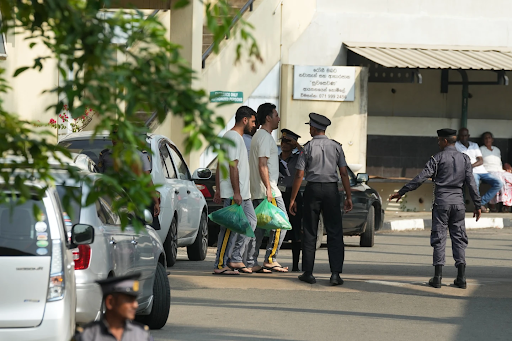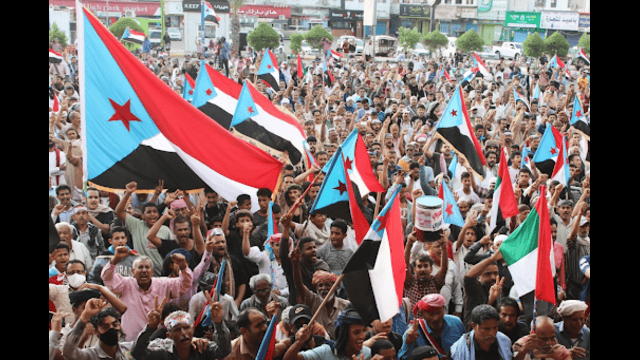
Supporters of the Southern Transitional Council (STC), a coalition of separatist groups seeking to restore the state of South Yemen, hold South Yemen flags during a rally, in Aden, Yemen, Friday, Jan. 2, 2026.
Violence erupted in southern Yemen after security forces confronted demonstrators backing a powerful separatist movement.
The clashes left at least five people dead and dozens injured, deepening political tensions in an already fragile region.
The incident unfolded in Shabwa governorate, an area that has seen growing unrest in recent months.
Officials and separatist representatives confirmed the casualties on Wednesday.
The violence followed a Yemeni separatist protest that quickly spiraled into deadly confrontation.
Protest Escalates in Ataq City
The unrest began in Ataq, the provincial capital of Shabwa.
Supporters of the Southern Transitional Council gathered near a government administrative building.
Witnesses said protesters stormed the premises during the demonstration.
According to local residents, some demonstrators attempted to remove the Yemeni national flag.
That action prompted an immediate response from local security forces.
Troops moved quickly to regain control of the building and surrounding streets.
Security units were later deployed across key areas of the city.
Authorities said the situation was brought under control within hours.
Officials Describe “Painful Events”
Eshraq al-Maqtari, Yemen’s newly appointed legal affairs minister, addressed the unrest publicly.
She described the clashes as “painful events” for Shabwa and its residents.
Her statement emphasized the human cost of continued political conflict.
Al-Maqtari urged local leaders and community figures to act responsibly.
She warned that ordinary citizens were paying the price for political rivalries.
Her message called for unity and calm over narrow political interests.
Separatists Confirm Deaths
The Southern Transitional Council’s local branch confirmed the deaths of five protesters.
The group accused security forces of using excessive force during the demonstration.
Its statement painted a grim picture of how events unfolded.
According to the STC, armed personnel opened fire as protesters marched through the city.
The group claimed light and medium weapons were used against the crowd.
It said the shootings caused multiple deaths and serious injuries.
The STC also accused authorities of dismantling the protest stage.
It alleged armored vehicles surrounded the area, turning it into a battlefield-like scene.
Security Forces Push Back
Shabwa remains under the authority of Yemen’s Presidential Leadership Council.
The council is led by President Rashad al-Alimi.
Forces allied with the council reportedly intervened to disperse the crowd.
Officials said warning shots were fired to break up the gathering.
They argued the measures were necessary to restore order.
No immediate response addressed the separatists’ specific accusations.
Tensions Beyond Shabwa
The Yemeni separatist protest reflects wider instability across the south.
In December, the STC expanded its influence in nearby governorates.
Those moves displaced Saudi-aligned forces and heightened regional rivalries.
Clashes followed, and the separatist group later announced its dissolution.
Despite that announcement, public demonstrations continued in its support.
Many protesters renewed calls for an independent southern Yemen.
A Conflict With Deep Roots
Yemen’s civil war has dragged on for more than a decade.
The conflict blends tribal divisions, political disputes, and regional power struggles.
Southern separatism remains one of its most volatile elements.
STC leader Aidarous al-Zubaidi remains a polarizing figure.
He is wanted for treason by the internationally recognized government.
He currently resides in Abu Dhabi, according to officials.
Political Shifts Add Pressure
The unrest comes amid changes in Yemen’s national leadership.
Last week, President al-Alimi announced a new 35-member Cabinet.
Prime Minister Shae’a al-Zandani continues to serve as foreign minister.
Only two women were included in the new government lineup.
Observers say political restructuring has done little to ease southern grievances.
For residents of Shabwa, stability remains elusive as tensions continue to simmer.