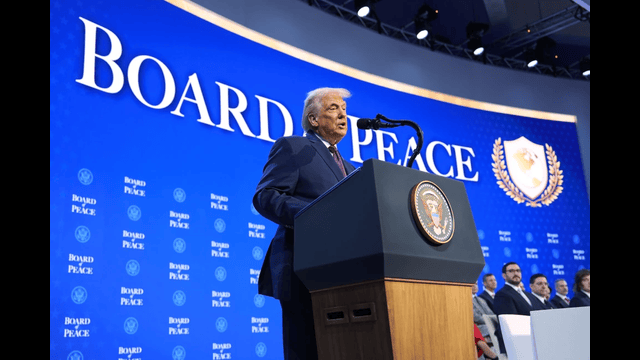
President Donald Trump speaks during a Board of Peace charter announcement during the Annual meeting of the World Economic Forum in Davos.
President Donald Trump says his newly formed Board of Peace has secured major financial pledges.
He announced that members promised about $5 billion for Gaza reconstruction and stabilization efforts.
The commitments will be formally revealed during the board’s inaugural meeting in Washington on Thursday.
Trump shared the update through a social media post on Sunday.
He described the initiative as potentially the most consequential international body ever created.
Trump will personally chair the Board of Peace as it begins operations.
Funding Promises Aim to Kick-Start Gaza Recovery
The $5 billion package is intended to support rebuilding across the devastated Gaza Strip.
Officials say the funding could also help establish international policing and stabilization forces.
Trump noted that participating nations will also send thousands of trained personnel.
However, the administration has not yet disclosed which countries pledged money or troops.
Details about the structure of the stabilization mission also remain limited for now.
Those specifics are expected once members gather for the official announcement.
Indonesia Signals First Concrete Military Commitment
Indonesia has already hinted at direct involvement in the Gaza mission.
Its military confirmed preparations for a possible humanitarian deployment.
Officials said up to 8,000 troops could be ready by late June.
This marks the first firm personnel signal tied to Trump’s Board of Peace Gaza reconstruction plan.
Other countries have not publicly confirmed participation in the security force.
Diplomats suggest several governments remain cautious about joining.
Enormous Reconstruction Challenge Still Looms
Despite the pledges, rebuilding Gaza remains an immense financial challenge.
International agencies estimate the full reconstruction cost near $70 billion.
The estimate comes from joint assessments by global financial and development institutions.
Large areas of Gaza suffered heavy destruction after more than two years of conflict.
Few neighborhoods escaped the extensive Israeli bombardment during the prolonged fighting.
Infrastructure damage includes housing, utilities, hospitals, and transportation networks.
Ceasefire Agreement Calls for Security Oversight
The October 10 U.S.-brokered ceasefire aimed to halt the Israel–Hamas war.
Although major battles slowed, security tensions continue across the territory.
Israeli forces still conduct periodic airstrikes and maintain military-controlled zones.
Under the ceasefire framework, an armed international stabilization force is required.
Its mandate would include maintaining order and supporting the disarming of Hamas.
Israel considers the disarmament condition central to any long-term settlement.
Still, only a handful of countries have shown real interest in joining.
This uncertainty complicates planning for Gaza’s immediate postwar security structure.
Attendance Questions Surround First Washington Meeting
Officials have not confirmed how many board members will attend Thursday’s gathering.
More than twenty countries are believed to belong to the Board of Peace.
Yet several leaders have not publicly committed to participation.
Israeli Prime Minister Benjamin Netanyahu is not expected at the inaugural session.
He recently met Trump at the White House for separate bilateral discussions.
The administration has not explained whether future meetings will include Israeli leadership.
A Broader Global Role for the New Board
Trump initially framed the Board of Peace as a Gaza-focused diplomatic mechanism.
However, the initiative now appears designed for a wider international mission.
Officials say the body could address conflicts and crises beyond the Middle East.
Analysts view this expansion as part of Trump’s larger foreign policy vision.
Some believe the plan attempts to reshape the existing global diplomatic structure.
Others argue it reflects continued U.S. frustration with United Nations processes.
Several traditional U.S. allies have declined membership invitations so far.
European partners reportedly fear the board could rival the UN Security Council.
That concern has slowed broader international participation.
Venue Choice Adds Political Controversy
Trump confirmed the meeting will occur at the U.S. Institute of Peace headquarters.
The administration recently renamed the building the Donald J. Trump U.S. Institute of Peace.
The property remains under legal dispute following last year’s federal takeover.
Former institute staff filed lawsuits after the government seized the facility.
Most employees were dismissed during the administrative restructuring.
That ongoing litigation continues alongside preparations for Thursday’s gathering.
High Stakes for Gaza Reconstruction Diplomacy
The Board of Peace Gaza reconstruction initiative now faces its first major test.
Thursday’s meeting will reveal whether pledges translate into actionable commitments.
For Gaza’s residents, the speed of rebuilding may depend on those outcomes.
If funding, troops, and coordination materialize, recovery could begin sooner.
If not, the region may face prolonged instability and humanitarian pressure.
Global attention now turns to Washington as the board prepares to convene.