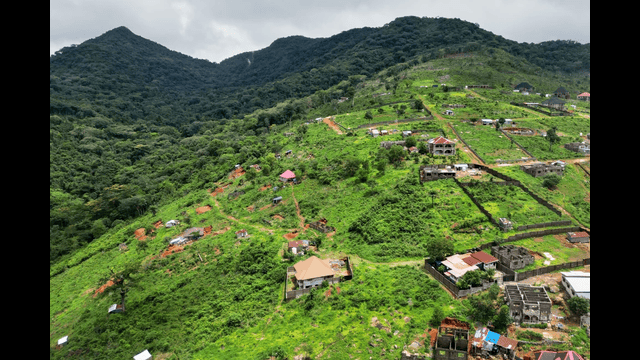
An aerial view of construction near Tacugama Chimpanzee Sanctuary in Western Area Peninsula National Park, Sierra Leone, Friday, July 4, 2025.
An investigation has uncovered widespread illegal mansion construction inside a protected national park in Sierra Leone. The findings suggest senior officials enabled land deals while enforcement agencies failed to intervene. Despite warnings about environmental risks, construction activity continues near a vital water reservoir serving the capital, Freetown.
Hidden Report Exposes Sierra Leone National Park's Illegal Mansions
A government investigation into Sierra Leone national park's illegal mansions began in 2022. President Julius Maada Bio ordered the probe after rising environmental concerns.
However, the report’s full findings were never publicly released.
Investigators later shared documents showing senior officials issued questionable land ownership papers.
These approvals allegedly allowed luxury housing projects to expand inside protected forest land.
Journalists visiting the area confirmed construction has not stopped.
Several new buildings appeared even after the investigation’s conclusions reached senior leadership.
Bio Barray Settlement Expands Into Protected Forest
Much of the illegal construction sits in the Bio Barray neighbourhood.
Parts of this settlement extend into the Western Area Peninsula National Park.
The park acts as a critical environmental shield for the coastal capital.
Authorities have even proposed the forest for UNESCO World Heritage status.
Yet at least fifty homes have already been built or remain under construction there.
Environmental experts warn the rapid deforestation threatens fragile mountain ecosystems.
Investigators described the destruction as an “environmental time bomb” requiring urgent action.
Reservoir Safety Raises Alarm
Above the illegal housing zone lies a key water reservoir.
This reservoir supplies nearly ninety percent of Freetown’s drinking water.
Officials fear continued forest clearing could destabilize surrounding hillsides.
The investigation warned deforestation may trigger a severe water shortage crisis.
Uncontrolled construction also increases the risk of landslides during heavy rains.
Sierra Leone has faced deadly landslides before.
A catastrophic 2017 disaster killed more than one thousand people near the park boundary.
Mayor Claims Powerful Figures Ignored the Law
Freetown Mayor Yvonne Aki-Sawyerr said authorities knew about the illegal expansion.
She argued influential individuals received permission while ordinary citizens faced strict rules.
According to her, powerful residents were simply allowed to bypass regulations.
The mayor, also an environmental advocate, plans to challenge the president in future elections.
Her comments intensified political attention around the Sierra Leone national park illegal mansions controversy.
Investigation Details Widespread Forest Clearing
The inquiry involved police officers, lawyers, and anti-corruption officials.
Members examined satellite images and reviewed land permit records carefully.
They confirmed extensive forest clearing despite an official construction ban.
The most serious encroachment occurred around the Bio Barray hillside area.
Investigators said tree loss accelerated rapidly in the months before the probe.
Water company leadership warned the clearing threatened the reservoir’s long-term stability.
Loose soil and slope damage could increase flood and landslide risks.
Land Ministry Accused of Facilitating Encroachment
The report stated the Ministry of Lands knew about unlawful occupation.
Officials allegedly hesitated to act firmly for unclear reasons.
Some were accused of encouraging settlements for personal benefit.
Former minister Denis Sandy reportedly signed at least 175 land lease documents.
Investigators labelled those approvals a serious legal violation.
They recommended disciplinary measures against Sandy and sixteen other officials.
Sandy did not publicly respond to repeated requests for comment.
Confusion Over Enforcement and Accountability
The findings reportedly reached top government offices in September 2022.
Later statements admitted “people in high places” were involved in deforestation.
The president promised action would follow soon.
Yet enforcement progress remains unclear years later.
Satellite analysis shows many illegal mansions still standing inside park boundaries.
Construction crews were also seen finishing additional homes last year.
Chief Minister David Sengeh later said government bodies had taken action.
However, he declined to confirm whether punishments were officially approved.
Anti-Corruption Agency Yet to Launch Probe
The head of Sierra Leone’s Anti-Corruption Commission said no investigation had started.
He also stated he had not reviewed the original inquiry report.
He emphasized other agencies must protect national parks independently.
Meanwhile, the National Protected Area Authority denied involvement in land sales.
Its former director was later removed for failing to stop encroachment effectively.
Future Uncertain for Park Protection
In 2025, President Bio declared nobody stands above land laws.
He even said illegal homes would be demolished regardless of ownership.
Still, many disputed properties remain occupied today.
Investigators identified 876 landowners within the park boundary.
Only 301 responded when asked to provide ownership documents.
A later survey identified dozens of villas linked to government workers.
These included staff from presidential offices and environmental agencies.
For now, Sierra Leone national park illegal mansions remain a visible symbol of weak enforcement.
Environmentalists warn that without urgent action, the forest and water supply face serious danger.