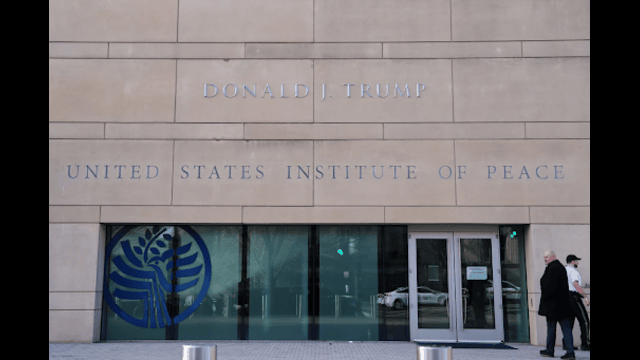
President Donald Trump’s name is seen on the US Institute of Peace building, Dec 4, 2025, in Washington.
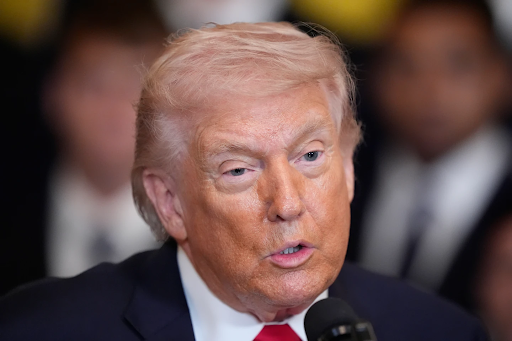
President Donald Trump is hosting the first meeting of his new Board of Peace on Thursday.
The gathering includes representatives from more than two dozen participating countries and several observer nations.
Talks will focus on rebuilding Gaza and planning an international stabilization force while a fragile ceasefire holds.
Trump Board of Peace Targets Gaza Reconstruction
The Trump Board of Peace was created under his broader Gaza peace initiative.
Officials say members have already pledged about $5 billion for reconstruction efforts.
However, estimates suggest rebuilding Gaza may require nearly $70 billion overall.
Trump described the coalition as a historic global leadership effort.
He said the group could become one of the most consequential international bodies ever formed.
The meeting is expected to outline funding commitments and security contributions from member countries.
Thousands of personnel may eventually support policing and stabilization missions inside the territory.
Leaders hope these forces could help maintain order during Gaza’s recovery phase.
Expanding Mission Raises International Questions
Originally, the Trump Board of Peace focused mainly on ending the Gaza conflict.
Since the October ceasefire, Trump has expanded its proposed responsibilities significantly.
He now wants the organization to address broader global conflicts beyond the Middle East.
This wider ambition has unsettled several U.S. allies and diplomatic observers.
Some fear the initiative could evolve into a rival institution challenging the United Nations.
Trump recently suggested the board could push the U.N. toward more effective action.
He acknowledged the U.N.’s potential but argued it has not fulfilled expectations.
The comments intensified debate about the board’s long-term geopolitical role.
Allies Attend but Some Hold Back Membership
More than 40 countries and the European Union confirmed attendance at the meeting.
Several nations will participate only as observers rather than full members.
Germany, Italy, Norway, and Switzerland fall into that observer category.
Diplomatic scheduling tensions also surfaced this week.
The U.N. Security Council moved a Gaza meeting earlier to avoid conflicts.
Officials feared overlapping events would disrupt travel for attending diplomats.
Vatican and Critics Urge U.N. Leadership
Vatican Secretary of State Cardinal Pietro Parolin emphasized the United Nations’ central crisis-management role.
He said international conflicts should primarily remain under U.N. supervision.
The White House strongly rejected those concerns on Wednesday.
Press Secretary Karoline Leavitt defended the Trump Board of Peace as legitimate and active.
She argued the initiative already includes dozens of countries supporting Gaza reconstruction.
U.S. Ambassador Mike Waltz also dismissed structural criticisms.
He said the new board focuses on action rather than prolonged diplomatic discussion.
According to Waltz, traditional approaches had failed to produce results.
Disarming Hamas Remains the Core Challenge
Security discussions will dominate much of the Thursday agenda.
A proposed international stabilization force would oversee Gaza’s demilitarization process.
Israel considers Hamas disarmament essential for any lasting ceasefire.
So far, Indonesia is the only country offering a firm troop commitment.
Hamas has shown limited willingness to accept full disarmament terms.
U.S. officials admit the process faces serious obstacles.
Still, mediators report cautious signs of possible cooperation.
Indonesia’s President Prabowo Subianto pledged coordination with other Islamic nations.
He stressed that achieving lasting peace requires continued international effort.
Governance Plans Also Under Review
The Gaza Executive Board will present operational updates during the meeting.
Officials are working on systems for governance, services, and public administration.
These structures aim to stabilize daily life during reconstruction.
Several prominent figures are scheduled to address the conference.
Speakers include Secretary of State Marco Rubio and envoy Steve Witkoff.
Jared Kushner, Tony Blair, Nickolay Mladenov, and Mike Waltz will also participate.
Analysts Say Skepticism Is Understandable
Policy analysts note uncertainty surrounding the board’s expanding mandate.
Michael Hanna of the International Crisis Group highlighted allies’ cautious responses.
He said many nations hesitate without clear authorization beyond Gaza operations.
Still, several governments joined hoping to influence U.S. engagement constructively.
They want Washington to use its leverage with Israel effectively.
For now, the Trump Board of Peace begins its work amid both hope and hesitation.