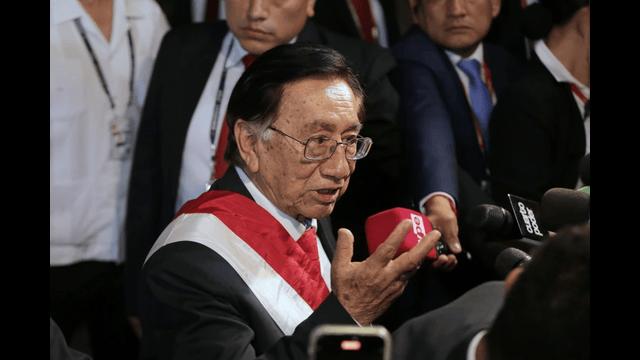
Peru’s new President Jose Maria Balcazar speaks with the press as he arrives at the government palace a day after voting to remove interim President Jose Jeri from office in Lima.
Peru has sworn in a new interim leader after another sudden presidential collapse. Lawmakers elected veteran politician José María Balcázar as the country’s eighth president in ten turbulent years. The appointment highlights Peru’s deep political instability and the urgency of restoring public trust before the upcoming national elections.
Congress Picks a Veteran Judge to Lead
Peru’s Congress selected Balcázar during a late-night legislative vote on Wednesday.
The 83-year-old former judge represents the Perú Libre party and secured majority support.
He defeated three rival candidates in the 130-member chamber after intense negotiations.
Balcázar was sworn in soon after the result became official.
The oath was administered by congressional president Fernando Rospigliosi during a brief ceremony.
His presidency is temporary and will last only five months.
A Presidency Marked by Constant Turnover
The José María Balcázar Peruvian president transition reflects a prolonged national political crisis.
In recent years, leaders rarely held stable legislative coalitions or consistent parliamentary backing.
Congress has repeatedly removed presidents using the constitutional clause of “permanent moral incapacity.”
This broad interpretation has allowed lawmakers to dismiss multiple heads of state.
The result has been a revolving leadership system and repeated institutional disruption.
Elections Now Shape the Short-Term Agenda
Balcázar’s central mission is to guide Peru toward scheduled national elections.
Voters will elect both a new president and legislature on April 12.
If no candidate secures a majority, a runoff vote will follow in June.
Political parties and civic groups are already demanding strict transparency guarantees.
Many citizens fear renewed instability if the electoral process faces disputes.
Balcázar assured reporters the vote would be fully credible and unquestionable.
He also pledged to maintain existing macroeconomic and monetary policies.
According to him, stability will allow investors and businesses to operate without fear.
Crime Surge Adds Urgency to Leadership
Beyond elections, Peru faces a worsening internal security challenge.
Murders, extortion, and organized crime networks have increased sharply in urban areas.
Small business owners and working families report growing intimidation and financial losses.
Balcázar promised renewed attention to combating organized criminal groups.
He said restoring public safety remains essential for national recovery.
Security policy will likely dominate the final months of this interim administration.
The previous president was removed after corruption claims
The leadership shift followed the sudden removal of interim conservative president José Jerí.
Congress voted Tuesday to oust him after only four months in office.
His dismissal came amid corruption allegations and undisclosed meetings with foreign business figures.
Jerí claimed the meetings involved planning a cultural festival with Chinese partners.
However, prosecutors opened preliminary investigations into possible influence-peddling.
Authorities are examining claims of illegal sponsorship benefiting private interests.
A Pattern of Impeachments Continues
The current Congress, elected in 2021, has removed several national leaders.
Those impeached include Pedro Castillo, Dina Boluarte, and, most recently Jerí.
This repeated removal cycle has weakened institutional credibility and public confidence.
Jerí himself once served as congressional president in October 2025.
At that time, he stood next in the constitutional succession line.
He assumed the presidency after Boluarte left office without a vice president.
A Short Presidency With Heavy Expectations
Balcázar enters office with limited time but significant responsibility.
His background includes nearly three decades of judicial service.
Supporters believe his legal experience may help steady Peru’s political climate.
Still, the José María Balcázar Peruvian president's tenure remains strictly transitional.
His main task is ensuring stable governance until voters choose a permanent leader.
Whether that brief window restores confidence in Peru’s institutions remains uncertain.
For now, the nation once again prepares for elections under yet another new president.