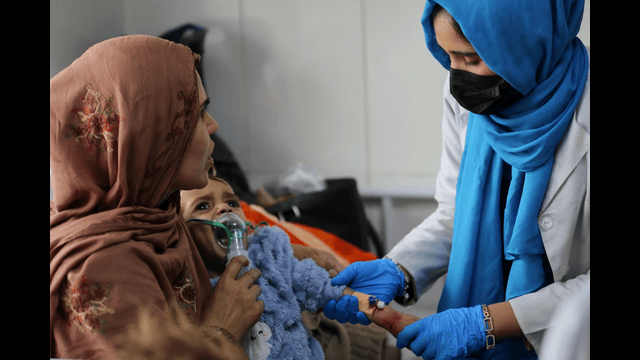
Latifa Bakkar attempts to give oxygen to her severely malnourished 2 and half year old baby.
A severe Afghanistan hunger crisis is worsening as humanitarian funding shrinks and food programs struggle to operate. Hospitals in Kabul are seeing growing numbers of starving children, while aid groups warn millions remain untreated. Families already burdened by poverty now face impossible choices as food shortages spread nationwide.
Hospitals Treat the Few Who Reach Care
At Kabul’s Indira Gandhi Children’s Hospital, doctors fight to save severely malnourished children every day.
One toddler arrived weighing barely half the healthy weight expected for his age.
After weeks of treatment, he survived, though many children never reach such facilities.
Medical workers say countless families cannot afford travel or treatment costs.
As a result, many sick children remain hidden in remote villages.
Aid Cuts Push Food Programs to Breaking Point
The Afghanistan hunger crisis has intensified after major international aid reductions.
According to the World Food Programme, funding shortages now force painful decisions.
Officials say they must turn away three out of four malnourished children.
Humanitarian leaders describe the situation as the worst malnutrition surge ever recorded locally.
Nearly four million Afghan children currently face acute hunger and life-threatening nutritional shortages.
Out of 17 million hungry citizens, only about two million still receive limited assistance.
Even those families now receive smaller food portions than before.
Years of Conflict and Disaster Fuel the Emergency
Afghanistan’s dependence on foreign aid stretches back decades of war and instability.
The Taliban takeover in 2021 sharply reduced direct international financial support.
Since then, economic collapse, drought, and earthquakes have deepened hardship.
Millions of displaced Afghans have also returned from neighboring countries recently.
Their return increased pressure on already stretched food supplies and fragile local services.
Humanitarian officials warn the combined impact has created a perfect storm of hunger.
Families Struggle After Food Assistance Ends
Many households report losing aid support years earlier.
Parents now rely on irregular work, borrowed money, or reduced meals.
Some mothers say they skip food entirely so their children can eat.
Unemployment among laborers and construction workers has worsened the crisis.
Without steady income, families often survive on minimal bread or tea.
Doctors say prolonged undernutrition is pushing more children into hospital wards.
Rising Child Deaths Raise Alarm
Relief agencies report hundreds of child deaths linked to hunger in recent months.
Officials believe the real number is much higher in isolated snow-covered regions.
Winter conditions often prevent deaths from being formally recorded.
Aid workers warn mortality will continue rising unless funding quickly increases.
They fear entire rural communities may soon face famine-like conditions.
Mothers Travel Far Seeking Treatment
Many desperate mothers travel long distances searching for medical care.
Some infants arrive suffering pneumonia, heart problems, and severe malnutrition simultaneously.
Doctors often struggle to stabilize such children after delayed treatment.
Parents remain anxious as recovery can take weeks or months.
Even after hospitalization, weight gain sometimes remains painfully slow.
Government Expands Treatment Centers
Afghanistan’s health ministry says it recognizes the scale of the hunger emergency.
Officials claim malnutrition treatment centers increased from 800 to roughly 3,200 nationwide.
Authorities say millions of mothers and children received treatment last year.
Government representatives stress hunger stems from decades of poverty and conflict.
They also confirm ongoing talks with international agencies about restoring funding support.
Women Face the Harshest Consequences
The Afghanistan hunger crisis hits women particularly hard under employment restrictions.
Widows and single mothers often lack income sources or family support.
Aid officials report increasing distress calls from women fearing their children will starve.
Nutrition programs also record a sharp rise in malnourished pregnant and breastfeeding mothers.
Experts say such increases were rarely seen in previous humanitarian emergencies.
A Growing Plea for Global Support
Relief leaders continue urging international donors not to abandon Afghan civilians.
They warn hunger, poverty, and child deaths will escalate without immediate intervention.
For millions of families, future survival now depends on renewed global assistance.
As hospitals fill and food supplies shrink, the Afghanistan hunger crisis shows no sign of easing.