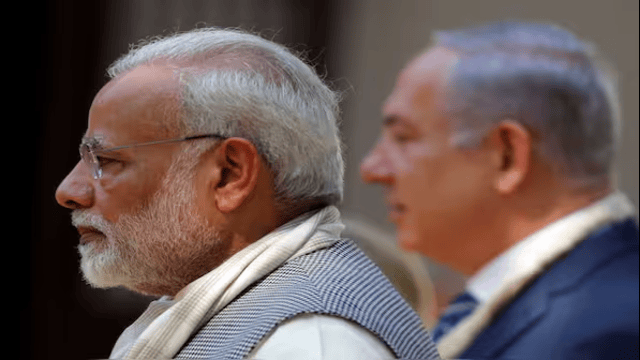
Prime Minister Narendra Modi will travel to Israel on Wednesday (February 25), where he will meet his Israeli counterpart Benjamin Netanyahu. (Reuters)
Prime Minister Narendra Modi will begin a two-day visit to Israel on February 25, where he is set to hold wide-ranging talks with Israeli counterpart Benjamin Netanyahu. Ahead of the trip, Netanyahu unveiled a new regional strategic vision — a proposed “Hexagon of Alliances” — and identified India as a key partner in the bloc.
A New Strategic Bloc In West Asia
Netanyahu described the proposed framework as a six-nation alliance bringing together countries in and around West Asia that share common security and economic interests. Besides India, he named Greece and Cyprus as potential members, while indicating that additional Arab, African and Asian countries could be included.
The grouping, he said, would focus on three pillars:
- Economic cooperation
- Diplomatic coordination
- Security collaboration
The Israeli leader positioned the initiative as a counterweight to Iran and its network of regional allies, often referred to by Israel as the “axis of resistance.”
Strategic Vision And Regional Messaging
According to Israeli officials, the alliance is meant to create a coordinated system of like-minded nations to address what Netanyahu called both a “radical Shia axis” and an “emerging radical Sunni axis,” though he did not elaborate on the latter.
The proposal has drawn sharp criticism from Hamas. Spokesperson Hazem Qassem warned that the plan could reshape regional power dynamics and urged Arab countries to resist joining such a framework, calling it a threat to regional stability.
Parallels With Imec Vision
Diplomatic observers see similarities between the proposed alliance and the India-Middle East-Europe Economic Corridor (IMEC), which aims to boost connectivity and economic integration across India, the Middle East and Europe.
Like IMEC, the Hexagon concept emphasises infrastructure, trade, technology and strategic connectivity — areas where India and Israel already have deep cooperation.
Netanyahu is likely to pitch the idea of the ‘hexagon of alliances’ to PM Modi during his two-day visit to Israel, starting Wednesday. AFP via FirstPost
What To Expect From Modi’s Visit
This will be Modi’s second visit to Israel since 2017 and comes months after the ceasefire in Gaza. The trip is expected to highlight the personal rapport between the two leaders and the steady expansion of bilateral ties.
Key developments likely during the visit include:
- Agreements in technology, artificial intelligence, agriculture and water management
- Expanded trade and innovation partnerships
- Deeper defence cooperation
India is also exploring joint work with Israel on advanced military systems, including missile defence, drones, laser weapons and long-range strike capabilities. Existing platforms such as Iron Dome, David’s Sling and Arrow are expected to feature in the discussions.
Modi is also scheduled to address the Knesset — a rare diplomatic honour.
A Relationship Framed As A Strategic Partnership
Both leaders have publicly emphasised their close working relationship. Netanyahu has called Modi a “dear friend,” while Modi has described India-Israel ties as rooted in trust, innovation and a shared commitment to peace and progress.
The visit is being seen as a significant step in shaping India’s role in emerging West Asian strategic and economic architectures.