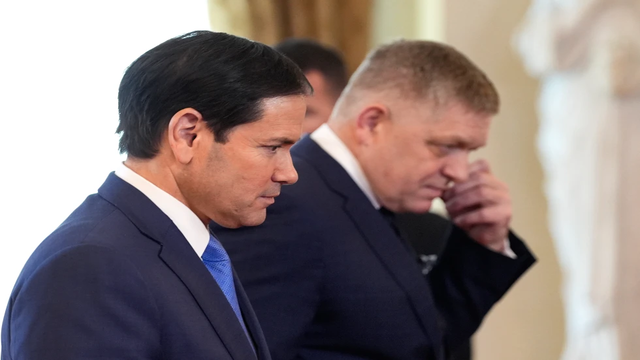
U.S. Secretary of State Marco Rubio, left, leaves with Slovakia’s Prime Minister Robert Fico after a joint news conference in Bratislava, Slovakia, Sunday, Feb. 15, 2026. (AP Photo)
Slovakia has cut off emergency electricity deliveries to Ukraine, intensifying a diplomatic and energy dispute linked to halted Russian oil flows through Ukrainian territory. The decision comes at a critical time for Ukraine, which continues to endure daily blackouts following sustained Russian attacks on its power plants and transmission networks.
The move marks one of the sharpest breaks in practical cooperation between the two neighbours since the war began and highlights the growing strain between energy security, domestic politics, and regional alliances.
Oil Disruption at the Heart of the Conflict
The standoff began after Russian crude shipments to Slovakia and Hungary through the Druzhba pipeline stopped on January 27. Ukrainian authorities say the interruption was caused by Russian drone strikes that damaged the infrastructure.
Bratislava disputes that explanation. Slovak Prime Minister Robert Fico insists the pipeline remains functional and has accused Ukraine of deliberately blocking the transit of oil.
Both Slovakia and Hungary still depend on Russian crude under temporary exemptions from the European Union’s ban on seaborne imports. The sudden disruption has therefore triggered what Fico described as an oil emergency at home.
Electricity Cut Framed as ‘Reciprocal’
Fico announced that Slovakia would immediately stop supplying emergency electricity to Ukraine after Ukrainian President Volodymyr Zelenskyy declined to hold urgent talks before mid-week.
He said the measure would be lifted as soon as oil deliveries resume, but warned that further steps could follow if the situation remains unresolved.
Among the possible consequences, Fico suggested Slovakia could withdraw its support for Ukraine’s ambition to join the European Union — a statement that signals how the energy dispute is spilling into broader geopolitical territory.
Kyiv Calls for Cooperation
Ukraine has pushed back against the accusations. Foreign Minister Andrii Sybiha urged both sides to act responsibly and return to constructive dialogue.
For Kyiv, the timing is particularly sensitive. The country is struggling to keep its energy system stable after months of Russian bombardment, and emergency electricity imports have been a crucial tool in preventing wider humanitarian disruption.
Opposition Criticism at Home
The decision has also sparked a political backlash within Slovakia. Opposition leaders have condemned the government for cutting power assistance to a country under attack, arguing the move damages Slovakia’s credibility within the European Union and weakens regional solidarity.
The dispute reflects Fico’s more sceptical stance toward EU policy on Ukraine and Russia — a position that has often put Bratislava at odds with the bloc’s mainstream approach.
Conflicting Claims Over Pipeline Damage
A central point of contention remains the actual condition of the Druzhba pipeline. Slovak officials say their intelligence services indicate the route is fully operational and claim their ambassador has not been allowed to inspect the section Ukraine says was damaged.
Kyiv, however, maintains that Russian strikes caused the disruption and rejects accusations of political manipulation.
Fico has gone further, describing the halt in oil transit as “blackmail” aimed at punishing Slovakia for its independent position on the war.
Wider European Implications
The row underscores the fragile balance between national energy needs and collective European policy. While most EU states have moved away from Russian oil, the exemptions granted to landlocked countries such as Slovakia and Hungary have left them vulnerable to supply shocks — and to political disputes linked to transit routes.
For Ukraine, the loss of Slovak emergency electricity adds another layer of pressure to an already strained power grid. For the European Union, the confrontation risks exposing internal divisions at a time when unity on Ukraine remains a central strategic goal.
Whether the electricity flows resume quickly will likely depend on technical verification of the pipeline’s condition — and on the willingness of both governments to step back from increasingly sharp rhetoric.