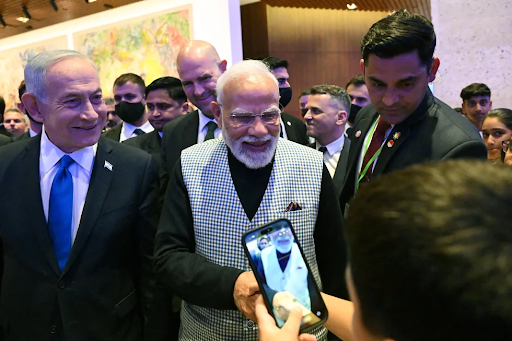
During the Modi Israel visit, PM Modi speaks at the Knesset, underscoring deeper India-Israel cooperation amid Gaza conflict.
Indian Prime Minister Narendra Modi received an emphatic welcome at Israel’s Parliament on Wednesday, using the moment to underline a deepening strategic partnership as Israel navigates diplomatic headwinds from the ongoing Gaza conflict. His address to the Knesset marked a significant chapter in India–Israel relations, blending symbolism with policy commitments that signal continued cooperation across security, trade and emerging technologies.
Standing before lawmakers in Jerusalem, Modi spoke of “friendship, respect and partnership,” urging both nations to remain steady partners in what he described as an uncertain global landscape. The applause that followed his 30-minute speech reflected how dramatically bilateral ties have evolved in recent years, especially under his leadership.
A War-Time Visit That Carries Diplomatic Weight
Modi’s visit comes at a delicate moment for Israel, which has faced mounting criticism internationally since the Gaza war erupted in October 2023. Against that backdrop, the Indian leader’s presence offered a measure of diplomatic reinforcement.
Israeli Prime Minister Benjamin Netanyahu greeted Modi warmly upon arrival, later introducing him in Parliament as a trusted friend and steadfast ally. Netanyahu publicly thanked Modi for standing by Israel in the immediate aftermath of the Oct. 7 attacks by Hamas, emphasizing that India’s support did not waver during a period of intense global scrutiny.
The optics of the visit were carefully choreographed. The Knesset building was illuminated in the colors of the Indian flag on the eve of his arrival, underscoring the importance Israel attached to the trip. After the speech, Knesset Speaker Amir Ohana presented Modi with a medal honoring his role in strengthening bilateral relations.
Political Undercurrents at the Knesset
Yet the occasion was not without domestic tensions. Opposition lawmakers briefly walked out during speeches by Netanyahu and Ohana, protesting the exclusion of Supreme Court Chief Justice Yitzhak Amit from the event. The protest was tied to broader disagreements over judicial reforms championed by Netanyahu, who is currently on trial for corruption charges.
When Modi rose to speak, however, opposition members returned to the chamber. Opposition leader Yair Lapid later clarified that the earlier walkout was unrelated to the Indian prime minister’s presence, ensuring that the focus remained on diplomacy rather than internal Israeli politics.
Expanding Strategic and Economic Cooperation
Beyond symbolism, the visit carried substantial policy implications. Modi indicated that India is committed to expanding cooperation across security, artificial intelligence, quantum technology and infrastructure development. He stressed that stronger trade ties and increased investment flows would form a central pillar of the next phase in relations.
India is already Israel’s second-largest trading partner in Asia. According to India’s Ministry of Commerce and Industry, bilateral trade reached $3.6 billion during the 2025 fiscal year, reflecting steady economic engagement despite global volatility.
The two leaders are expected to formalize several agreements covering economic, political and defense collaboration. Modi is also scheduled to meet Israeli President Isaac Herzog and visit the Yad Vashem Holocaust memorial, adding historical reflection to a trip largely defined by forward-looking strategy.
India’s Position on Gaza and Regional Stability
While reaffirming strong ties with Israel, Modi also reiterated India’s support for a U.S.-backed ceasefire framework for Gaza that received endorsement from the U.N. Security Council last year. He described the plan as offering hope for a just and durable peace, including progress on the Palestinian issue.
Notably, Modi did not address Israel’s recently approved measures to expand its control in the occupied West Bank. Earlier this month, India joined more than 100 countries in expressing concern over those steps, which critics argue weaken the Palestinian Authority.
That careful balance illustrates India’s evolving foreign policy. Historically aligned with Palestinian aspirations, New Delhi has steadily broadened its engagement with Israel since establishing full diplomatic ties in 1992. Modi became the first Indian prime minister to visit Israel in 2017, marking a decisive shift toward open strategic alignment.
As his latest visit concludes, the message appears clear: India intends to maintain close cooperation with Israel while positioning itself as a pragmatic actor seeking stability in a turbulent region.