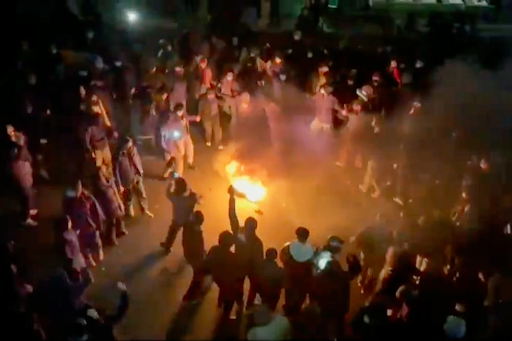
Students chant during Iran college protests as tensions grow over US military threats and the country’s nuclear dispute.
Seven weeks after Iranian authorities crushed sweeping nationwide demonstrations, unrest continues to ripple across university campuses. Although the streets have largely fallen quiet, college students are again voicing dissent, keeping public resistance alive at a time when tensions with the United States are escalating over Iran’s nuclear program.
Over the past week alone, anti-government gatherings surfaced on at least ten campuses, according to student witnesses, social media footage verified by The Associated Press, and activists monitoring the movement from abroad. Many students described a deepening sense of anger toward the country’s leadership, coupled with uncertainty about Iran’s political future.
Campuses Reignite After Crackdown
The renewed activism follows a violent crackdown that authorities say left more than 3,000 people dead. Independent rights monitors dispute that figure, reporting significantly higher casualties and continuing investigations into thousands of additional deaths. Among those killed were at least 128 university students, according to exiled activist Ali Taghipour, who tracks campus movements. He called it the deadliest episode for students under the Islamic Republic.
Universities had briefly reopened for in-person classes just as families marked the 40-day memorials for victims of the January protests. Those commemorations became catalysts for new demonstrations, reigniting tensions that had simmered beneath the surface.
At institutions such as Sharif University of Technology and Amir Kabir University, students clashed with apparent pro-government supporters. Videos circulating online captured protesters chanting “Shameless! Shameless!” — a slogan often directed at security forces and members of the Basij militia, which maintains a presence on campuses.
Meanwhile, students at Al Zahra University and the University of Tehran’s College of Foreign Languages staged vocal rallies that began as memorials for slain classmates. Chants echoed through corridors, underscoring a shared frustration that has not faded despite weeks of repression.
Government Warnings and Growing Pressure
As protests persist at Iranian colleges, officials have sharpened their tone. Government spokesperson Fatemeh Mohajerani warned students against crossing what she described as a “red line,” while judiciary chief Gholamhossein Mohseni Ejehi signaled that courts would intervene if university administrators failed to contain dissent. In recent months, Ejehi has become closely associated with expedited punishments for protesters.
Many campuses have shifted back to remote instruction, a tactic authorities used earlier when unrest spread from Tehran’s grand bazaar to cities nationwide. Internet slowdowns and disciplinary hearings have further restricted student organizing, with some facing suspension or expulsion.
For many young Iranians, the crackdown has deepened skepticism about the possibility of reform. University activism has long played a defining role in the country’s political life, from the 1999 student protests to the demonstrations surrounding the disputed 2009 presidential election. More recently, campus voices fueled the nationwide protests of 2022, which openly challenged the theocratic system led by Supreme Leader Ali Khamenei.
A Generation Caught Between Repression and War
Today’s students find themselves navigating not only domestic repression but also the specter of foreign military action. As Washington weighs its response to Tehran’s nuclear program, fears of a potential U.S. strike have unsettled campuses further.
Some students say the government’s refusal to enact meaningful policy changes, combined with economic strain from sanctions and mismanagement, has eroded faith in gradual reform. That vacuum has amplified support in some circles for Reza Pahlavi, the exiled son of Iran’s former monarch. Yet his advocacy for stronger international pressure, including possible military intervention, has divided opinion among young activists.
A student in the northern city of Babol described growing anxiety about what conflict could mean for a country already struggling with electricity shortages and strained public services. While he hopes for a democratic and secular future, he worries that war would only intensify suffering and risk national fragmentation.
On campuses where remote learning continues, some students are boycotting virtual classes as a form of protest. Others admit they feel uncertain about where the movement can lead, caught between a government willing to use force and foreign powers whose involvement could reshape the country in unpredictable ways.
For now, the protests persist at Iranian colleges, sustained by grief, frustration, and a determination to be heard. Whether these voices will translate into lasting political change remains unclear, but the tension coursing through Iran’s universities shows that dissent, though suppressed, has not disappeared.