Officials reveal the China growth target for 2026 during the National People’s Congress as policymakers address economic slowdown and global risks.
China has set a lower economic growth target for 2026, signaling a cautious approach as domestic pressures and global uncertainty weigh on the world’s second-largest economy. The government announced that it aims for annual growth between 4.5% and 5%, slightly below recent targets, reflecting concerns over a prolonged property slump, weak consumer demand, and geopolitical tensions.
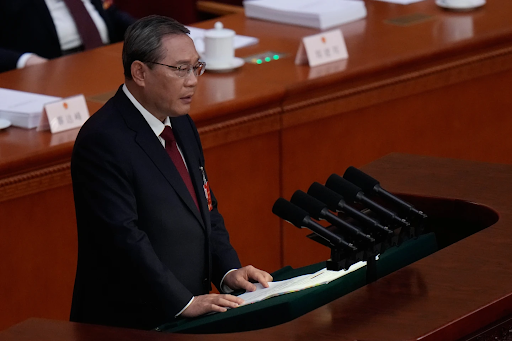
The target was presented by Chinese Premier Li Qiang during his report to the opening session of the National People’s Congress. The figure marks China’s lowest official growth target since 1991 and follows 5% economic expansion in 2025, which matched the government’s goal for the previous three years.
Li acknowledged the challenges ahead while highlighting the country’s achievements. He said policymakers remain aware of the economic pressures facing China both at home and abroad, emphasizing that the government will pursue stability while addressing emerging risks.
Balancing Growth and Technological Ambitions
China’s leadership is attempting to strike a careful balance between reviving domestic economic activity and advancing long-term strategic ambitions. At the center of these ambitions is President Xi Jinping, who has prioritized turning China into a global powerhouse in fields such as artificial intelligence, robotics, and advanced manufacturing.
At the same time, the government is working to reduce dependence on foreign technologies, particularly high-end semiconductors. These goals reflect a broader strategy of strengthening industrial self-reliance while maintaining steady economic growth.
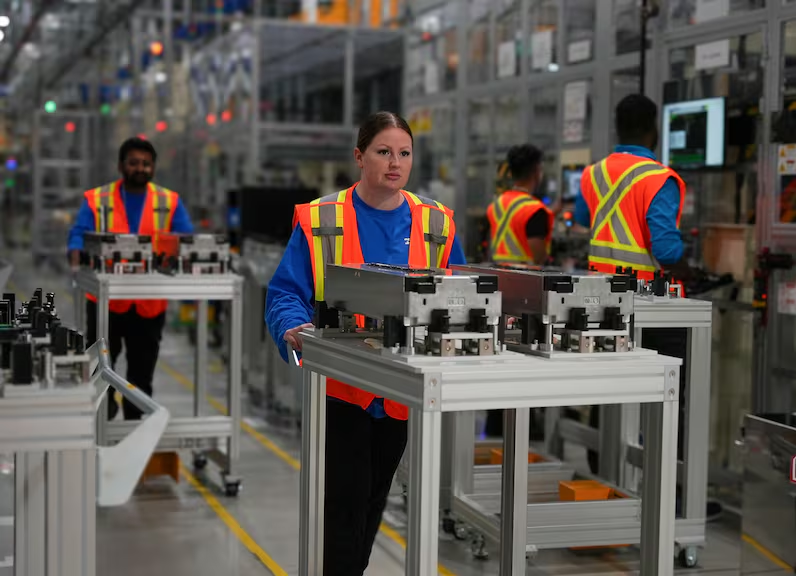
Despite the slower target, Beijing signaled continuity in its economic policy. The annual government report indicated that authorities will continue supporting domestic demand but are unlikely to introduce large-scale stimulus measures. Analysts say this approach suggests that policymakers are prioritizing industrial resilience and technological innovation over rapid consumer-driven expansion.
A Complex Global and Domestic Environment
China’s economic outlook is being shaped by a mix of global and domestic pressures. Rising geopolitical tensions and disruptions to global trade are adding uncertainty to an already challenging environment.
The government report warned that free trade faces growing risks, citing increasing geopolitical friction and external shocks. Energy security is another concern, as China and many other Asian economies rely heavily on oil and natural gas imports from the Middle East. Ongoing conflicts in the region have pushed energy prices higher and raised fears about supply disruptions.
At home, the government highlighted a structural imbalance between strong manufacturing output and weaker consumer demand. Shifting the economy toward new sources of growth remains a major challenge for policymakers.
Efforts to Boost Consumer Spending
One of China’s biggest economic hurdles is sluggish domestic consumption. While the country has managed to sustain growth through exports, consumer spending has remained subdued as households cope with job insecurity and declining property values.
To encourage spending, the government plans to issue 250 billion yuan (about $36 billion) in special bonds. The funds will support programs offering rebates to consumers who replace older cars, appliances, and other household goods with new ones.
Authorities are also introducing city-level housing policies aimed at stabilizing the real estate market. These measures include managing housing supply and reducing large inventories of unsold homes.
The property downturn has had a noticeable impact on workers in the sector. For example, real estate agent He Meiru said property transactions have slowed dramatically, with deals now occurring only every few months. His income has fallen to about 10,000 yuan ($1,400) per month, less than one-third of what he earned five years ago.
Economists say restoring consumer confidence will require more than short-term incentives. Greater social welfare support and stronger job security could encourage households to spend more rather than save.
Defense Spending and Military Reforms
Alongside economic planning, China also released its defense budget for the coming year. The government proposed a 7% increase in military spending, slightly lower than the 7.2% rise seen in recent years. The new defense budget would reach approximately 1.9 trillion yuan ($270 billion).
The spending plan comes during a period of significant changes within the military leadership. Several senior officials have been removed amid corruption investigations, part of a broader effort to modernize the armed forces and reinforce the ruling party’s authority.
Officials reiterated the government’s commitment to maintaining strict political control over the military. The report emphasized the need for political loyalty and improved conduct within the armed forces.
A Measured Path Forward
China’s lower economic growth target for 2026 reflects a pragmatic response to a challenging economic landscape. While policymakers remain focused on technological advancement and industrial strength, reviving domestic consumption and stabilizing the property sector will be critical for long-term stability.
As global uncertainties persist and internal reforms continue, China appears set to pursue steady, measured growth rather than aggressive expansion in the years ahead.