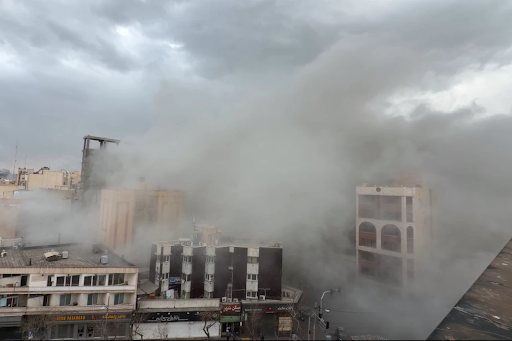
Israeli strikes hit military sites in Iran and Beirut as regional tensions surge, raising fears of a wider Middle East conflict and escalation.
A fresh wave of Israeli strikes on Iran and Lebanon has sharply intensified tensions across the Middle East, as the United States warns the ongoing bombardment could escalate dramatically. Early Friday morning, powerful airstrikes hit multiple locations in Iran while fighting also flared in Lebanon, expanding a conflict that is increasingly drawing in regional powers and threatening wider instability.
Witnesses in Iran described heavy explosions shaking neighborhoods in Tehran as Israel launched what it called a “broad-scale wave of strikes.” The attacks targeted key military infrastructure, including missile bases and air defense systems. Israeli officials said the campaign has already destroyed a large portion of Iran’s missile launchers and defensive capabilities.
Meanwhile, reports from western Iran indicated additional blasts near the city of Kermanshah, an area known to house several strategic missile installations. The growing intensity of the strikes signaled a significant escalation in a war that has already spread beyond traditional battle lines.
U.S. Strike Targets Iranian Drone Carrier
Amid the escalating conflict, the United States confirmed that its military struck an Iranian drone carrier operating at sea. The vessel, known as the IRIS Shahid Bagheri, reportedly caught fire following the attack.
U.S. Central Command released footage showing the burning ship, though Iranian officials had not immediately acknowledged the strike. The drone carrier, a converted container vessel equipped with a long runway for launching drones, was considered a major addition to Iran’s naval capabilities when it was unveiled in 2025.
Admiral Brad Cooper, head of U.S. Central Command, compared the vessel’s size to that of a World War II aircraft carrier. He said the ship was actively burning after the strike, signaling another major blow to Iran’s military infrastructure.
The U.S. also reported further military operations inside Iran. Under the cover of darkness, B-2 stealth bombers dropped dozens of heavy “penetrator” bombs designed to destroy deeply buried ballistic missile launchers. According to U.S. officials, additional strikes targeted facilities linked to Iran’s space and missile command systems.
Iran Expands Retaliatory Attacks Across the Region
In response, Iran launched a new round of retaliatory missile and drone attacks targeting countries that host U.S. military forces. The strikes reached several Gulf states, including Kuwait, Qatar, Saudi Arabia and Bahrain.
Defense authorities in Qatar said air defenses intercepted a drone approaching Al Udeid Air Base, which houses the forward headquarters of U.S. Central Command. Saudi Arabia reported destroying three ballistic missiles aimed at Prince Sultan Air Base near Riyadh.
Air raid sirens also sounded across Bahrain after Iranian strikes reportedly targeted two hotels and a residential building. Officials said there were no immediate casualties. In Kuwait, where six American troops were killed earlier in the week, the country’s air defense systems were activated after missiles and drones entered its airspace.
U.S. officials said Iranian attacks have now affected at least a dozen countries in the region, underscoring how rapidly the conflict is expanding.
Leadership Uncertainty Inside Iran
As the military conflict intensifies, Iran is also facing growing political uncertainty. Iranian state media reported that a leadership council has begun discussions on how to convene the Assembly of Experts, the clerical body responsible for choosing the country’s next supreme leader.
The move follows the death of Supreme Leader Ayatollah Ali Khamenei during the opening strikes of the war. The council currently includes President Masoud Pezeshkian, judiciary chief Gholam Hossein Mohseni Ejehi, and senior cleric Ayatollah Ali Reza Arafi.
Officials have not yet indicated when the Assembly of Experts will meet or how the vote will take place. Several buildings connected to the clerical body have already been damaged in the ongoing airstrike campaign.
Israeli Strikes Hit Beirut as Fighting Resumes with Hezbollah
Beyond Iran, Israeli strikes also intensified in Lebanon as clashes with Hezbollah resumed. Late Thursday and early Friday, Israeli forces launched at least 11 airstrikes targeting southern suburbs of Beirut.
The Israeli military warned residents in advance to evacuate immediately, prompting many civilians to flee their homes. Fires were reported near a gas station, and two hospitals evacuated patients and staff as a precaution.
Lebanon’s health ministry said the renewed fighting has pushed the death toll in the country to at least 123 since hostilities resumed. United Nations peacekeepers stationed in southern Lebanon also reported witnessing increased clashes, including ground combat near the border.
A Conflict Spreading Across the Middle East
The widening war has already claimed significant casualties across the region. Officials report that at least 1,230 people have been killed in Iran, more than 120 in Lebanon, and around a dozen in Israel. Six U.S. troops have also died during the conflict.
With attacks spreading to multiple countries and military operations intensifying, U.S. Defense Secretary Pete Hegseth warned that the scale of the bombardment could soon increase further. As regional forces brace for additional strikes, the Middle East faces the growing risk of an even broader confrontation in the days ahead.