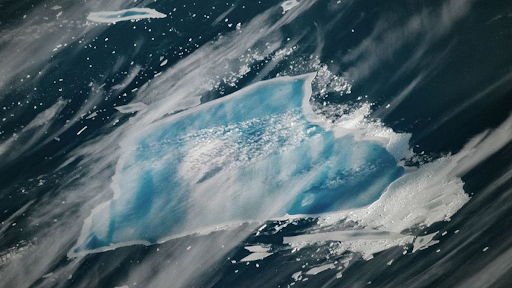
The photo shows iceberg A-23A as seen from the International Space Station on Dec. 27, 2025. Photo credit: NASA. NASA
A massive iceberg that broke away from Antarctica nearly 40 years ago has entered its final stage of life. Known as A-23A, the iceberg has begun turning a striking blue colour as it breaks apart in warmer waters. Satellite images show that the change happened quickly, marking what scientists believe are its last days.
Experts say the blue colour comes from pools of meltwater collecting on the iceberg’s surface. This water fills cracks and cavities, making the ice weaker and speeding up the breakup process.
“I certainly don't expect A-23A to last through the austral summer,” says Chris Shuman, a retired Earth scientist.
Why the Iceberg Changed Colour
Most icebergs appear white because trapped air bubbles scatter light. Over time, ice becomes denser as pressure squeezes out the air, making it clearer and bluer. However, A-23A does not fit the usual pattern.
This iceberg has turned blue because it is melting fast. The meltwater gathers on top and sinks into cracks. The added weight pushes the cracks open, causing pieces to break away faster than before.
The iceberg now drifts in summer waters near the boundary between the Southern Ocean and the South Atlantic, not far from the Falkland Islands and South Georgia Island.
A Long and Unusual Journey
A-23A broke off from Antarctica’s Filchner Ice Shelf in 1986. Soon after, it became stuck on the seafloor in the Weddell Sea, where it stayed mostly unchanged for about 30 years. In 2023, it finally broke free but soon became trapped again in a spinning ocean current called a Taylor column.
In March 2025, the iceberg got stuck on the ocean floor once more. It freed itself by June, but scientists then noticed rapid damage. Large chunks began breaking away, and the iceberg shrank at an increasing pace.
In January 2025, A-23A covered about 3,640 square kilometres and ranked as the largest iceberg on Earth. By September, its size dropped to around 1,700 square kilometres. As of Jan. 9, 2026, it measured only 1,182 square kilometres.
On the Edge of Disappearing
Recent satellite images from NASA show white edges around the iceberg. This feature forms when ice melts faster at the waterline, creating a raised rim that traps meltwater on top. With nowhere else to go, the water seeps down through the ice, forcing cracks open.
NASA reports that A-23A now sits “on the verge of complete disintegration.” Meltwater pressure may already have punched holes through parts of the iceberg, spilling fresh water into the sea.
The iceberg now drifts toward an area often called an iceberg graveyard near South Georgia Island, where it will fully melt and return to the ocean.
“I’m incredibly grateful that we’ve had the satellite resources in place that have allowed us to track it,” Shuman says. “Its path has been remarkably long and eventful. It’s hard to believe it won’t be with us much longer.”