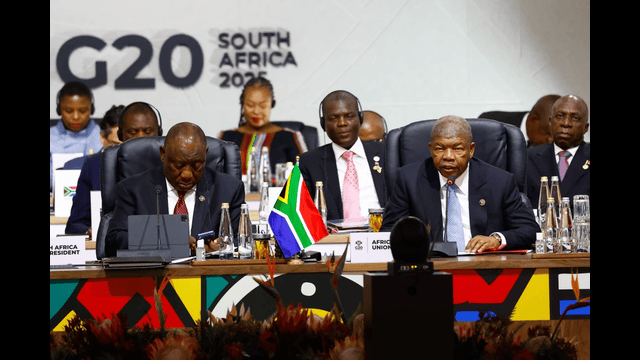
South African President Cyril Ramaphosa and Chairperson of the African Union Joao Lourenco attend a plenary session on the opening day of the G20 Summit, in Johannesburg, South Africa, Saturday, Nov. 22, 2025.
African leaders gathered in Ethiopia this weekend for the annual African Union Summit.
The meeting focuses on the future of a continent with nearly 1.4 billion people.
However, public confidence in the African Union is weakening, especially among younger citizens.
Many now question whether the regional body truly represents their interests.
Youth Frustration Shadows the African Union Summit
The African Union was created to promote unity and cooperation among African states.
Yet analysts say the organization now faces a serious legitimacy challenge.
Young Africans increasingly feel excluded from continental decision-making processes.
Economic hardship, political instability, and declining foreign aid have intensified these frustrations.
Across several countries, citizens are confronting coups, disputed elections, and widespread protests.
These crises have deepened doubts about the African Union’s effectiveness.
Many young voters believe the institution reacts slowly to democratic violations.
A Young Continent Led by Aging Leadership
Africa holds the world’s youngest population, with over 400 million people aged between 15 and 35.
At the same time, several nations are governed by long-serving leaders.
This striking contrast has fueled political dissatisfaction and instability in multiple regions.
Demographic projections show Africa’s youth population could double by 2050.
Despite rapid population growth, living standards continue declining in many communities.
Online discussions often describe the African Union as dominated by older political elites.
Critics argue that youth priorities rarely receive meaningful policy attention.
Analyst Liesl Louw-Vaudran noted the organization often focuses more on governments than citizens.
She said many young Africans want a people-driven institution.
Instead, they see a structure shaped largely by state leadership interests.
Election Disputes Raise Credibility Questions
Recent elections across Africa have intensified criticism of the African Union.
Several contests featured sidelined opposition candidates and contested vote counts.
Young voters frequently led protests challenging declared results.
Observers say the African Union often congratulates incumbents too quickly.
At the same time, it appears slower to publicly criticize flawed electoral practices.
This perceived imbalance has damaged the organization’s credibility among youth groups.
Uganda’s presidential election became a widely discussed example.
Authorities restricted internet access and detained opposition supporters during the vote.
Despite these reports, the African Union Commission initially praised the election process.
Later, an observer report acknowledged harassment and intimidation complaints.
The mixed messaging triggered anger on social media platforms.
Some users mocked the organization and questioned its neutrality.
Structural Weakness Limits Enforcement Power
Experts say the African Union struggles to enforce its own resolutions effectively.
Professor Macharia Munene argues compliance remains inconsistent among member states.
Some countries fail to pay membership dues or fully accept collective decisions.
This weakens the organization’s authority and operational capacity.
Without stronger enforcement tools, critics believe reforms will remain difficult.
Many citizens see declarations issued by the body as largely symbolic.
African Union Summit Meets a Changing Global Landscape
The current African Union Summit is taking place in Addis Ababa, Ethiopia.
This year’s official theme centers on water access and sanitation challenges.
Leaders are also discussing climate pressures and humanitarian funding gaps.
Foreign aid reductions from major partners have increased urgency for coordinated responses.
Diplomats say the summit offers a chance to reshape partnerships globally.
Shifting alliances and geopolitical tensions are influencing Africa’s strategic planning.
Some observers link these changes to broader debates about an emerging global order.
They say African leaders want stronger bargaining positions internationally.
Citizens Demand Accountability and Real Action
Despite global discussions, many citizens want the African Union to focus inward.
They urge stronger accountability mechanisms for national leaders.
Security crises, corruption, and unemployment remain immediate public concerns.
In Abuja, Nigerian resident Chima Ekwueme voiced frustration openly.
He questioned why the African Union rarely intervenes during severe domestic crises.
Nigeria’s wealth in natural resources, he noted, contrasts sharply with widespread hardship.
For many young Africans, the African Union Summit represents a critical test.
They want policies that deliver measurable improvements in governance and economic stability.
Whether leaders respond convincingly may shape the institution’s future public trust.