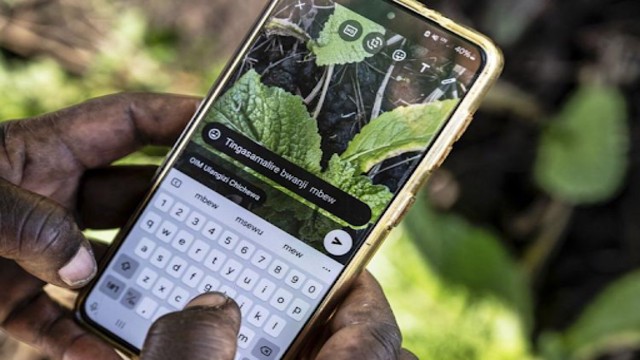
A farmer uses the Ulangizi AI chatbot in Mulanje, southern Malawi, July 29, 2025. (AP Photo)
When Cyclone Freddy ripped through southern Malawi in 2023, it left devastation in its wake. For 59-year-old farmer Alex Maere, decades of hard work vanished overnight. His fertile land in Sazola, near Mount Mulanje, turned into barren sand and rock.
Once able to harvest nearly 850 kilograms of corn each season, Maere managed only eight kilograms after the storm. With five children depending on him, he knew his traditional farming methods were no longer enough.
That crisis pushed him to embrace an unlikely ally — artificial intelligence.
AI Technology Offers Fresh Solutions
Maere is now among thousands of small-scale farmers turning to Ulangizi, a generative AI chatbot created by Opportunity International. Backed by the Malawian government, the tool is designed to provide practical farming advice at a time when climate shocks are crippling food production.
The chatbot suggested Maere diversify by planting potatoes alongside corn and cassava. He followed the advice closely, growing half a soccer field’s worth of potatoes. The result was life-changing — sales worth more than $800. For the first time in years, he paid his children’s school fees without worry.
“Everything changed when I listened,” he said with a smile.
Farming at the Heart of a Nation
More than 80% of Malawi’s 21 million people depend on agriculture. But repeated cyclones, droughts, and poor yields have left the nation facing a severe food crisis. With national elections looming, farming remains one of the most urgent political issues.
Across sub-Saharan Africa, smallholder farms produce most of the food supply, yet productivity lags behind global levels. AI is now emerging as a bridge, offering solutions ranging from crop disease detection to drought forecasting. Private investment in agriculture tech in the region surged from $10 million in 2014 to $600 million by 2022.
Breaking Barriers of Access
But innovation comes with obstacles. Africa’s hundreds of languages, widespread illiteracy, and patchy internet make AI adoption difficult.
“One of the biggest challenges is accessibility,” explained Malawian technology expert Daniel Mvalo. “If AI fails once, farmers may lose trust forever.”
Ulangizi attempts to overcome these barriers. Available through WhatsApp in Chichewa and English, it allows farmers to type, speak, or even send photos of crop problems. The chatbot then responds with audio or text guidance.
Still, many smallholders lack smartphones or reliable internet. To fill the gap, “farmer support agents” like 33-year-old Patrick Napanja carry devices loaded with the app. Each agent supports 150 to 200 farmers, often traveling from village to village.
“I used to struggle with tough questions,” Napanja admitted. “Now I get answers through the app.”
Connectivity remains an issue. Farmers sometimes spend half their meeting waiting for responses to load. Other times, agents hike up hills just to find a signal.
A Fragile, But Growing Trust
For families living on the edge of poverty, one wrong answer can be disastrous. That is why Ulangizi aligns its advice with Malawi’s official agricultural guidelines. Government officials say this builds trust while ensuring consistency.
“Farmers who have access are helping their neighbors,” noted agriculture officer Webster Jassi. “That community spirit is amplifying results.”
For Maere, the technology offers more than advice. It represents resilience in the face of climate change — and hope that his children’s future may still be secure.