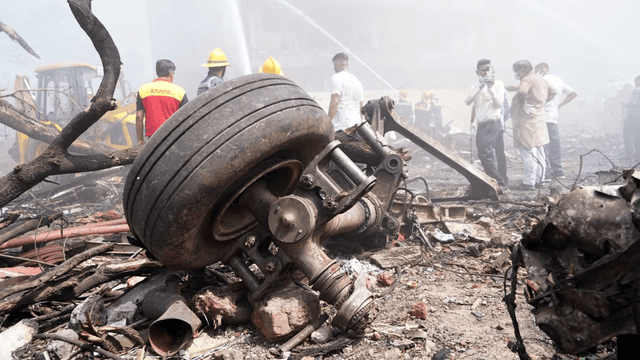
Aircraft landing gear is seen at the crash site of Air India Ltd. flight AI171 in Ahmedabad, Gujarat, India, on June 12.
A sudden loss of engine fuel supply led to the tragic crash of Air India Flight 171 last month, according to a preliminary report by India’s Aircraft Accident Investigation Bureau (AAIB). The crash, which occurred shortly after takeoff from Ahmedabad, resulted in the deaths of 260 people. Only one passenger survived the devastating incident.
Fuel Cutoff Switches Flipped Mid-Air
The Boeing 787-8 Dreamliner was en route to London Gatwick on June 12 when disaster struck moments after takeoff. As the plane reached an airspeed of 180 knots, both engines abruptly lost power. Data recovered from the aircraft’s black box revealed that the fuel control switches—critical for engine operation—had been switched from "RUN" to "CUTOFF" within one second of each other.
This action starved the engines of fuel, causing them to shut down mid-air.
Confusion in the Cockpit
Cockpit audio captured a brief but alarming exchange between the pilots. One asked, “Why did you cutoff?” to which the other responded, “I didn’t.” The report suggests a lack of clarity in the cockpit, raising concerns about crew coordination and situational awareness.
The switches were reversed moments later, and the engines began attempting an automatic relight. However, the aircraft had already begun to lose altitude rapidly.
Final Moments and MAYDAY Call
The Ram Air Turbine—a backup power source—was seen deployed in airport surveillance footage, confirming a loss of main electrical power. The Dreamliner began its descent, struggling to recover thrust.
Within seconds of the relight attempt, one of the pilots declared, “MAYDAY MAYDAY MAYDAY.” Air traffic control responded immediately, but received no further communication. The jet plummeted and crashed into the BJ Medical College and Hospital hostel near the airport, killing several people on the ground as well.
Safety Features Designed to Prevent This
According to aviation safety analyst David Soucie, the fuel cutoff switches in Boeing 787 aircraft are carefully designed to avoid accidental activation. They are guarded by metal bars and feature locking mechanisms.
“These switches don’t move themselves,” Soucie emphasized. “It's extremely rare to see both switched off accidentally.”
Experienced Crew at the Helm
The captain was a seasoned 56-year-old pilot with more than 15,000 flying hours. His first officer, aged 32, had clocked over 3,400 hours. Both were considered highly competent.
The report found no abnormalities in pre-flight equipment settings. Flaps, landing gear, and fuel quality were all confirmed to be within safety norms. There was no evidence of bird activity or weather interference. The aircraft's weight was within limits, and no hazardous cargo was on board.
Recent Engine Installations Confirmed
The Dreamliner had recently undergone maintenance. The left engine had been installed on March 26 and the right on May 1. However, both engines were reported to be functioning normally before the incident.
Passengers and Ground Casualties
Flight 171 carried 242 passengers and crew, including 169 Indians, 53 Britons, seven Portuguese, and one Canadian. Tragically, many were also killed on the ground when the aircraft crashed into a student hostel building.
The death toll has now reached 260, marking it as one of India’s deadliest aviation disasters in recent years.
Air India Responds to Tragedy
Air India has acknowledged the preliminary findings and pledged full cooperation with ongoing investigations.
“Air India stands in solidarity with the families and those affected by the AI171 accident,” the airline posted on X (formerly Twitter). “We continue to mourn the loss and are fully committed to providing support during this difficult time.”
The final investigation report is still pending. Meanwhile, the aviation industry and the public alike await clearer answers on how such a rare technical misstep turned into a national tragedy.