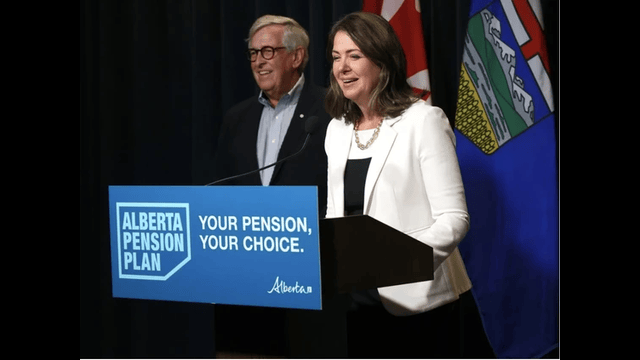
Alberta Premier Danielle Smith.
The Alberta government is exploring a major shift, moving away from the Canada Pension Plan (CPP) to create a provincial alternative. While technical debates continue, the real question is: could Albertans gain more in retirement with their own pension plan?
Early analysis says yes.
Alberta's Strong Economic Advantage
Alberta has a unique edge. It enjoys higher average incomes, lower unemployment, and a younger population compared to the rest of Canada. Because of this, Albertans contribute more to the CPP than what local retirees actually receive. This imbalance has led to growing interest in a made-in-Alberta pension plan.
Under such a plan, workers in Alberta could see lower payroll deductions while still receiving equivalent pension benefits. The money saved on contributions could then be invested privately, helping individuals build greater retirement wealth.
What the Numbers Say
According to a Fraser Institute study from 2019, Alberta’s pension contribution rate could drop from 9.9% (CPP rate) to just 5.85% with its own plan.
Let’s break this down with an example. Imagine you’re an Albertan earning $50,000 in 2025. If you start contributing at 18, you could save around $50,023 over your working life by switching to the lower rate.
If you invest those savings in a private retirement account like a TFSA or RRSP, the returns could be significant. With compound interest, those savings could grow to $189,773. Combined with $264,968 from the Alberta pension plan, your total pre-tax retirement income would hit $454,741.
That’s a 71.6% increase compared to relying solely on CPP benefits.
A Second Scenario, Still Profitable
Not all experts agree on the exact numbers. Another estimate by economist Trevor Tombe suggests a higher contribution rate of 8.21% for an Alberta pension plan. Even then, the benefits remain strong.
In this case, the same Albertan worker earning $50,000 could still accumulate $329,640 in total retirement income. That’s 24.4% more than the projected $264,968 from CPP.
While the extra income is smaller compared to the earlier example, it’s still a meaningful boost.
Higher Retirement Income Through Private Savings
The key difference lies in how Albertans use their savings. A lower contribution rate doesn’t mean smaller pensions—it means more freedom to invest privately. Those private investments, combined with public pension payouts, can significantly enhance total retirement income.
This shift gives workers more control over their financial future. Even with higher contribution estimates, the potential payoff remains greater than what the CPP offers.
The Bigger Picture for Alberta Workers
The debate over an Alberta pension plan is far from over. But early projections suggest one clear trend—Albertans could see higher retirement income under a provincial plan. Lower contributions, paired with smart private investing, might deliver better financial outcomes than the current national system.
As the province gathers public feedback, one thing is clear: Albertans deserve to know all the facts—and all their options.