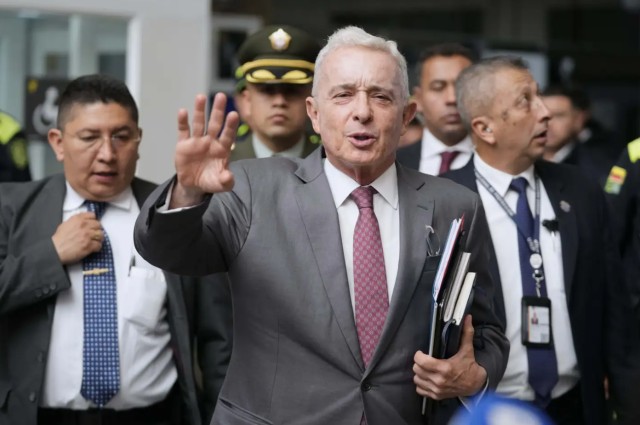
Former President Alvaro Uribe leaves court after a hearing in his trial over witness tampering and bribery charges in Bogota, Colombia, Feb. 10, 2025.
Colombia's former President Álvaro Uribe has been sentenced to 12 years of house arrest for witness tampering and bribery. The ruling marks a dramatic fall for one of the country's most influential and polarizing political figures.
The court found Uribe guilty of trying to manipulate witnesses connected to accusations of paramilitary ties during his early political career. His sentencing comes after a six-month trial and years of legal wrangling.
A Historic Verdict Shakes Colombia
This is the first time a former Colombian president has been convicted in such a high-profile criminal case. The ruling has divided public opinion across the nation. Some see justice served; others call it political persecution.
Uribe, who led the country from 2002 to 2010, was known for his tough stance on crime and guerilla groups. He still holds a strong base of support, particularly among conservatives and business elites.
“Politics Over Law,” Says Uribe
After the verdict, Uribe strongly denied any wrongdoing. Speaking after the hearing, he said, “Politics prevailed over the law in sentencing.” The 73-year-old former leader has vowed to appeal the decision.
Judge Sandra Heredia, who presided over the trial, denied his request to remain free during the appeals process. She cited concerns that Uribe might flee the country and evade justice. The court also banned him from holding public office for eight years and imposed a fine of around $776,000.
Case Rooted in Allegations of Paramilitary Ties
The case dates back over a decade. Uribe initially filed a libel suit in 2012 against leftist senator Iván Cepeda, who had accused him of links to paramilitary groups. But in a major twist, Colombia’s Supreme Court dismissed the charges against Cepeda in 2018 and instead began investigating Uribe.
According to Judge Heredia, Uribe conspired with a lawyer to influence three former paramilitary members in prison. They were allegedly persuaded to retract testimonies given to Cepeda, undermining the senator’s investigation.
Appeal Underway, Final Verdict Months Away
Uribe has already started preparing arguments for his appeal. He posted on social media ahead of the ruling, saying one must “think more about the solution than the problem” during personal trials. The appeals court has until October to decide, and the final outcome could reach the Supreme Court.
A Divided Public Reacts
The court's decision has stirred passionate responses across Colombia. In Bogotá, longtime Uribe supporter Martha Peñuela Rosales said she wept after hearing the news. “It’s an unjust sentence. He deserves to be free,” she said.
Outside the courthouse, anti-Uribe protester Sergio Andrés Parra welcomed the ruling. “The 12-year sentence is enough,” he said. “Even if he appeals, history has already condemned him.”
Legacy of a Controversial Leader
Uribe’s presidency was marked by a fierce campaign against rebel groups, especially the FARC. Under his leadership, Colombia’s military weakened the insurgency and pushed peace talks that ultimately led to the 2016 disarmament of over 13,000 fighters.
Yet his legacy remains deeply controversial. Many credit him with stabilizing Colombia during a time of crisis. Others accuse him of enabling human rights violations and empowering paramilitary forces that committed atrocities.
As Uribe’s legal battle continues, the case has become more than just a courtroom drama. It has reopened old wounds and sparked new debates about power, accountability, and justice in Colombian politics.