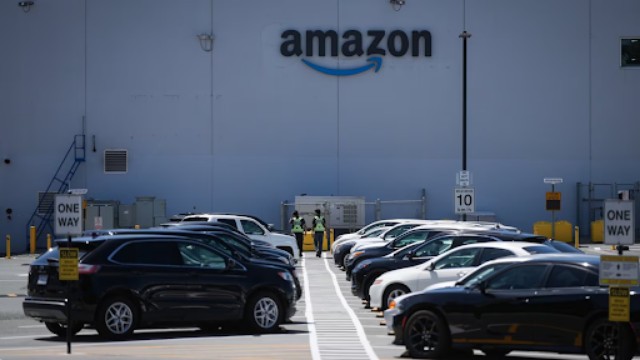
Security personnel patrol the parking area outside Amazon's YVR2 warehouse in Delta, British Columbia. (Photo: Darryl Dyck / The Canadian Press)
Amazon’s efforts to stop workers from forming a union at its Delta, British Columbia, warehouse have failed once more. The province’s Labour Relations Board has rejected the company’s appeal to overturn a decision that officially allowed workers to unionize.
Back in July, the board ruled in favour of the workers after finding that Amazon had deliberately hired more employees in an attempt to weaken union support. The board believed the move was a calculated strategy to prevent workers from reaching the numbers needed to gain union certification.
Unifor, the union that led the organization efforts, provided solid proof that Amazon’s sudden hiring spree was not just for regular operations. Instead, the company appeared to be padding the employee count to sway the outcome. The board said this tactic clearly crossed the line.
In its latest ruling, the Labour Board emphasized that Amazon’s actions were not only wrong but also deeply unfair to the workers. The panel called the company’s hiring practices “a serious interference” in the right of workers to join a union. According to them, intentionally manipulating the employee list during a union drive is a serious violation of workers’ rights.
Amazon, however, is not backing down. Company spokesperson Eileen Hards released a statement saying the ruling was incorrect and unfair. She said Amazon would continue to fight the decision and determine its next legal steps.
Amazon’s legal team had claimed that the increase in staff was necessary due to business demands. They also defended their actions by saying the company had a right to express anti-union views under free speech laws. But the board strongly disagreed, stating that the company's behaviour went beyond simple expression and clearly interfered with the union process.
The panel highlighted that this was a textbook example of an employer trying to disrupt union efforts. It said Amazon’s actions were serious enough to justify the initial decision to give workers the right to unionize without a vote. The board also made it clear that such behaviour is an attack on workers’ freedom to associate and organize.
Unifor’s national president, Lana Payne, welcomed the decision, calling it a strong warning to other employers in British Columbia. She said businesses must respect workers’ choices and not try to sabotage their organizing efforts—or face the consequences.
Amazon remains firm in its stance. The company insists that it only acted within its legal rights and that the board’s decision prevents employees from making a fully informed choice.
The back-and-forth between Amazon and the union is likely to continue, but for now, the ruling marks a major win for workers in their fight to be heard and protected on the job.