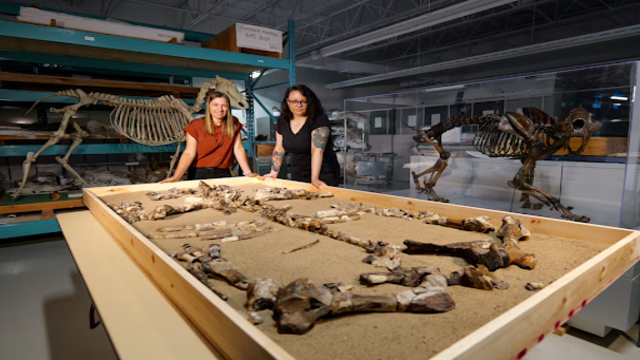
Scientists Marisa Gilbert and Danielle Fraser stand beside the fossil of an ancient hornless rhinoceros species, Epiaceratherium itjilik, which lived about 23 million years ago in Canada’s High Arctic. The fossil, displayed at the Canadian Museum of Nature in Ottawa, is shown in a photo released on October 27, 2025, by the museum. Reuters
Scientists have uncovered fossils of a hornless rhinoceros that lived in the Canadian High Arctic about 23 million years ago. The animal, named Epiaceratherium itjilik, roamed Devon Island in what is now Nunavut. The discovery offers new insight into how ancient mammals adapted to extreme northern environments long before modern species appeared.
Fossil Found in Haughton Crater
Researchers found the remains in Haughton Crater, a 23-kilometre-wide impact site on Devon Island. The fossilized skeleton, about 75 percent complete, gave scientists a detailed look at the animal’s structure. The rhino stood about one metre tall at the shoulder—roughly the same size as today’s Indian rhinoceros but without a horn.
According to the research team, the discovery marks the first time a rhinoceros species has been found so far north. It lived during the early Miocene epoch, a period when many mammal groups were evolving and spreading across the globe.
A Warmer Arctic Long Ago
Danielle Fraser, head of palaeobiology at the Canadian Museum of Nature in Ottawa, led the study. She explained that the Arctic looked very different during that time. “Devon Island during the Miocene was much more temperate and forested, quite unlike the polar desert that is there today,” Fraser said.
Summers were mild, while winters brought snow and months of darkness. Fraser compared the ancient Arctic climate to what we see today in southern Ontario or northern New York State. Despite the long, dark winters, plants still thrived—creating food sources for the rhino and other animals.
Life in a Forested Arctic
The fossil site also contained pollen from trees such as pine, birch, spruce, and alder, showing that the region was once a lush forest. Scientists believe the polar rhino fed on leaves and shrubs. Its narrow muzzle suggested it was a browser, similar to many modern herbivores.
Fraser said the animal might have had a furry coat to survive freezing winters. Although later species, like the woolly rhinoceros, grew thick fur and large horns, this Arctic rhino was not closely related to them.
Other fossils from the same area included Puijila darwini, an early seal that still had feet instead of flippers.
Clues to Ancient Migration
Researchers also examined proteins from the rhino’s tooth enamel, which helped trace its lineage. The results showed that its closest relatives lived in Europe, the Middle East, and southwestern Asia. This means its ancestors likely crossed from Europe into North America using a northern land bridge that remained open longer than scientists had believed.
“Our study says rhinos were crossing for at least 20 million years longer than we thought,” Fraser noted. Geological evidence now supports the idea that animals may have migrated from Europe over routes through Iceland or Svalbard into Greenland and then North America.
A Key to Mammal Evolution
Fraser emphasized the broader significance of the find. “We often think about the tropics as centres for biodiversity,” she said. “But the more fossil discoveries we make in the Arctic, the more it is becoming clear that it was an essential region in the evolution of mammals.”