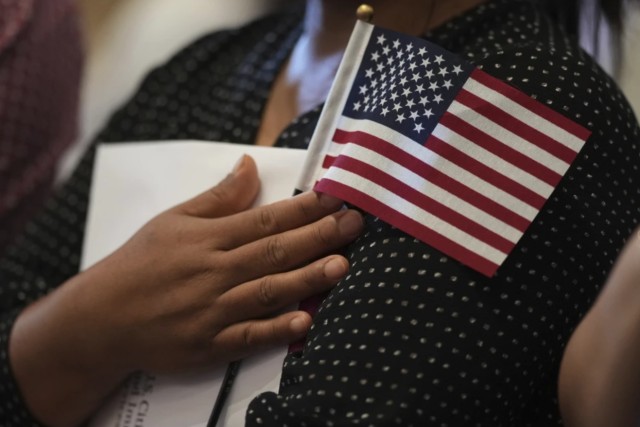
A woman clutches a U.S. flag as she and applicants from other countries prepare to take the oath of citizenship in commemoration of Independence Day during a Naturalization Ceremony in San Antonio, July 3, 2025.
Immigrants seeking lawful residency and work in the United States will now face stricter screening. U.S. Citizenship and Immigration Services (USCIS) has announced a new policy requiring officers to evaluate whether applicants hold “anti-American” views. The move has sparked debates over fairness, subjectivity, and constitutional concerns.
New Policy Targets ‘Anti-Americanism’
The updated guidelines state that immigration officers must examine whether applicants have “endorsed, promoted, supported, or otherwise espoused” anti-American, antisemitic, or terrorist ideologies.
“Immigration benefits—including to live and work in the United States—remain a privilege, not a right,” USCIS spokesperson Matthew Tragesser said. He emphasized that U.S. opportunities should not be extended to those who “despise the country.”
Unclear Definitions Raise Concerns
While the intent appears firm, the policy leaves crucial questions unanswered. Authorities have not defined what counts as “anti-Americanism.” Nor have they explained when or how officers should apply the directive.
This uncertainty is fueling concerns. Critics argue the ambiguity allows personal bias and stereotypes to influence life-changing decisions.
Experts Highlight Officer Discretion
Elizabeth Jacobs, Director of Regulatory Affairs at the Center for Immigration Studies, said the policy makes existing practices more explicit. Officers are not required to reject applicants outright but may weigh negative associations during reviews.
“The agency cannot tell officers that they have to deny—just to consider it as a negative discretion,” Jacobs explained. Still, she acknowledged that discretion opens the door to inconsistent rulings.
Fears of Bias and Prejudice
Not all experts are reassured. Jane Lilly Lopez, sociology professor at Brigham Young University, warned of a bigger problem.
“They are opening the door for stereotypes, prejudice, and implicit bias to take the wheel in these decisions,” Lopez said. For her, this creates a system where personal perceptions may overshadow objective assessment.
A Continuation of Stricter Immigration Checks
The policy is not an isolated change. Since the Trump administration, U.S. immigration laws have undergone tighter scrutiny. Recent measures include social media vetting and a broader evaluation of “good moral character” for naturalization applicants.
That requirement now involves more than avoiding misconduct. Applicants must show positive contributions to society. Lopez noted that immigrants now face a heavier burden to prove they meet standards.
Constitutional Debate Over Free Speech
Legal experts remain divided over whether such rules infringe on constitutional protections. Jacobs argued that First Amendment rights do not extend to foreigners outside the U.S. or those without citizenship.
In contrast, Ruby Robinson of the Michigan Immigrant Rights Center said constitutional protections apply to everyone within U.S. borders. “A lot of this administration’s activities infringe on constitutional rights and do need to be resolved in courts,” Robinson insisted.
Attorneys Advise Caution
Immigration lawyers are urging applicants to prepare for stricter evaluations. Jaime Diez, a Texas-based attorney, cautioned immigrants to understand the new reality.
“Things that apply to U.S. citizens are not going to apply to somebody trying to enter the United States,” Diez said.
Political Context and Policy Direction
Legal experts note that the change reflects the broader immigration stance of the Trump administration. Jonathan Grode, managing partner at Green and Spiegel, said the update is consistent with past actions.
“This is what was elected. They’re allowed to interpret the rules the way they want,” Grode explained. He added that while the law remains unchanged, the government continues to “shrink the strike zone.”
Immigration Debate Intensifies
The debate over screening for anti-Americanism adds another layer to the long-standing battle over U.S. immigration policy. Supporters argue it protects the nation from harmful ideologies. Critics warn it risks undermining fairness, equality, and constitutional values.
For immigrants hoping to live and work in America, the path now appears even more challenging.