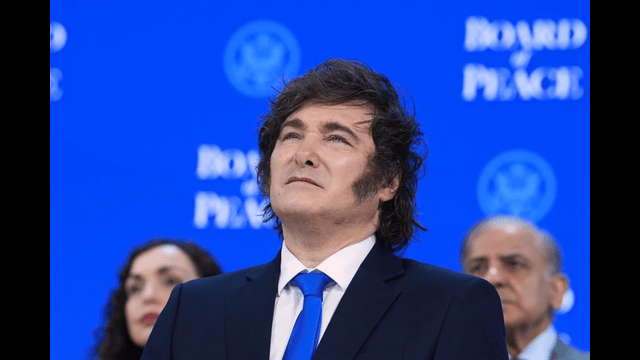
Javier Milei, President of Argentina, listens to speeches after the signing of a Board of Peace charter during the Annual Meeting of the World Economic Forum in Davos, Switzerland, Thursday, Jan. 22, 2026.
Argentina and the United States have sealed a sweeping trade agreement.
The deal cuts hundreds of tariffs on goods traded between both nations.
It also deepens a growing political alliance between their presidents.
For Buenos Aires, it marks a bold shift away from economic isolation.
For Washington, it supports efforts to lower food prices at home.
The Argentina US trade deal blends economics with clear ideological alignment.
President Javier Milei has made free markets his defining mission.
President Donald Trump has welcomed Milei as a loyal ally.
Thursday’s agreement reflects that shared worldview.
A Strategic Deal Beyond Economics
The agreement was signed in Washington on Thursday.
Argentine Foreign Minister Pablo Quirno led the delegation.
U.S. Trade Representative Jamieson Greer represented the Trump administration.
The deal eases trade restrictions across hundreds of product categories.
It also signals a reset for Argentina’s global trade posture.
For years, Argentina relied on heavy protectionism.
Milei has moved fast to dismantle that system.
He has aligned Argentina closely with U.S. foreign policy.
His support for Trump has been unusually visible.
Milei’s Loyalty Pays Dividends
Since taking office, Milei has visited the U.S. repeatedly.
He plans another visit to Trump’s Mar-a-Lago estate next week.
The relationship has produced tangible benefits.
Last year, Trump extended a $20 billion credit line to Argentina.
The move helped stabilize markets during financial turmoil.
It also helped Milei avoid a painful currency devaluation.
Milei later secured a strong midterm election victory.
Markets rallied as confidence returned.
The Argentina US trade deal builds on that momentum.
What Argentina Gains From the Deal
Argentina agreed to remove barriers on over 200 U.S. goods.
These include chemicals, machinery, and medical devices.
More sensitive products will enter under tariff-free quotas.
Vehicles, dairy products, and live cattle are among them.
These concessions worry domestic producers.
Many industries were long shielded from foreign competition.
Local manufacturers already face pressure from cheaper imports.
Chinese goods have flooded the market since reforms began.
Critics warn of job losses and factory closures.
What the US Brings to the Table
The U.S. will remove tariffs on 1,675 Argentine products.
Argentina expects export revenues to rise by over $1 billion.
Officials say the move boosts credibility with global investors.
The White House said the list includes rare natural resources.
It also covers pharmaceutical ingredients.
Argentina agreed to strengthen intellectual property protections.
Washington also pledged to review its 50% steel and aluminum tariffs.
However, those duties remain in place for now.
Argentine manufacturers expressed disappointment.
Argentine Beef Sparks Fresh Debate
One major provision involves Argentine beef imports.
The U.S. will quadruple low-tariff beef imports.
The cap rises to 100,000 tons per year.
The policy aims to reduce meat prices for Americans.
But it risks political backlash.
Ranchers and Republican lawmakers raised concerns before.
Similar outrage followed Trump’s earlier support for Argentina.
That included bond purchases and currency intervention.
Critics questioned aiding a struggling foreign economy.
Political Pushback Continues
Trump’s MAGA base remains skeptical.
Argentina is not a traditional U.S. trade partner.
Both countries export similar agricultural goods.
They compete in soy, corn, wheat, meat, and oil.
Democrats have also criticized the relationship.
They argue U.S. taxpayers shoulder unnecessary risk.
Senator Elizabeth Warren renewed those concerns Thursday.
She urged Treasury officials to end the $20 billion credit line.
The debate shows no signs of fading.
A Defining Moment for Argentina
Despite controversy, Argentina sees the deal as historic.
Quirno called it a signal of renewed trust.
He said Argentina is open, predictable, and reliable.
The Argentina US trade deal reshapes the country’s future.
It ties economic reform to political alignment.
Whether the gamble pays off remains to be seen.