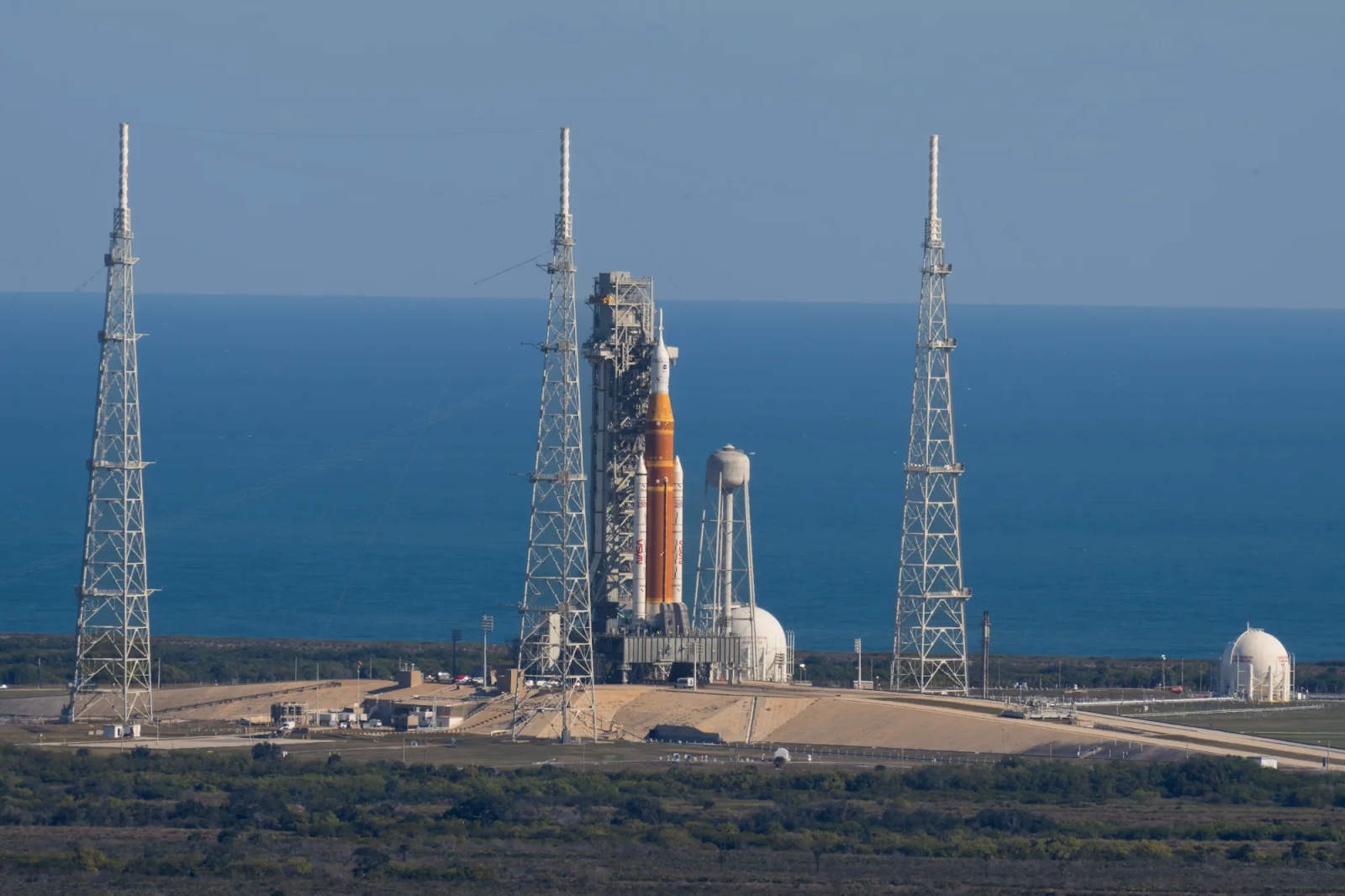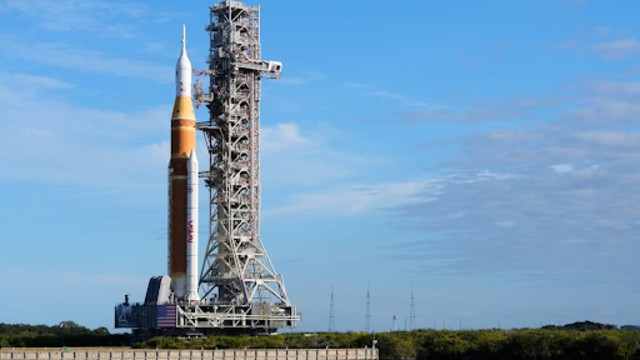
NASA's new moon rocket, Artemis II, slowly makes its way to pad 39B at the Kennedy Space Center, Saturday, Jan. 17, 2026, in Cape Canaveral, Fla.(AP Photo)
NASA has taken a major step toward returning humans to lunar orbit, rolling its massive Space Launch System (SLS) rocket and Orion spacecraft to the launch pad ahead of the Artemis 2 mission. The move signals the start of final testing for what will be the agency’s first crewed Moon mission in more than half a century.
Early Saturday, the orange-and-white rocket emerged from the Vehicle Assembly Building at Kennedy Space Center in Florida. The slow, carefully choreographed rollout — a journey of about four miles to Launch Pad 39B — is expected to take up to 12 hours and marks the beginning of a crucial pre-launch phase.
If upcoming tests go as planned, Artemis 2 could lift off as early as February 6, with a launch window stretching into late April.
A Return to Crewed Lunar Flight
Artemis 2 will send four astronauts — three from the United States and one from Canada — on a roughly 10-day journey around the Moon. The mission will not include a lunar landing, but it will push humans farther into deep space than they have traveled since the Apollo era.
The crew includes NASA astronauts Reid Wiseman, Victor Glover and Christina Koch, along with Canadian Space Agency astronaut Jeremy Hansen. All four were present at the space center to witness the rocket’s rollout.
“In just a few weeks, you’re going to see four humans fly around the Moon,” Hansen said. “If we’re doing that now, imagine what we can do next.”
NASA officials describe Artemis 2 as a critical proving mission, designed to validate life-support systems, navigation, and overall spacecraft performance before future landings.
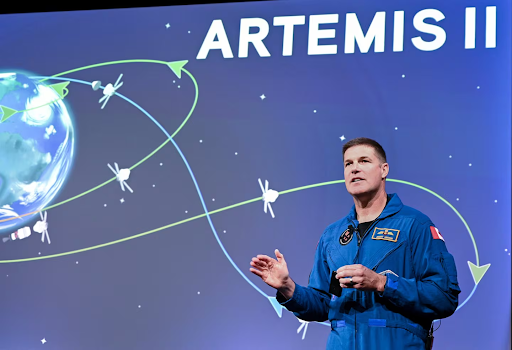
Astronaut Jeremy Hansen speaks about his upcoming Artemis II mission during an event at the Canadian Space Agency, in Longueuil, Que., on Thursday, Oct. 16, 2025.
Final Tests Before Launch
With the rocket now at the pad, engineers will begin a series of integrated tests to ensure the SLS and Orion are flight-ready. These include power-ups, system checks, and a full pre-launch rehearsal simulating countdown conditions.
“We’re making history,” said John Honeycutt, chair of the Artemis 2 mission management team. “This is a huge milestone for the program.”
The mission builds on Artemis 1, an uncrewed test flight completed in November 2022 after multiple delays and scrubbed launch attempts. That mission successfully sent Orion around the Moon and back, clearing the way for astronauts to return aboard the spacecraft.
Racing Against Time — and Rivals
The renewed push comes as global competition in space intensifies. NASA aims to return astronauts to the Moon before the end of the decade, even as China accelerates its own lunar ambitions.
China plans to launch its uncrewed Chang’e 7 mission in 2026 to explore the Moon’s south pole and is testing its crewed spacecraft, Mengzhou, later this year. Beijing has set a target of 2030 for its first crewed lunar mission.
NASA leaders say Artemis 2 is a vital step in maintaining U.S. leadership in deep-space exploration. The Moon, they argue, will serve as a testing ground for future human missions to Mars.
Delays Still Loom Over the Program
Despite the momentum, the Artemis program has faced persistent setbacks. Technical challenges, budget pressures, and shifting timelines have complicated progress.
NASA surprised many observers late last year by announcing that Artemis 2 could fly as early as February, a faster pace widely linked to pressure from the Trump administration to outpace China’s lunar timeline.
However, Artemis 3 — the mission intended to land astronauts on the Moon — is currently scheduled for 2027 and could slip further. Industry analysts point to delays in SpaceX’s Starship megarocket, which is critical for the lunar landing system.
Even so, crew members say the significance of Artemis 2 outweighs the uncertainties.
“We’re swinging for the fence,” astronaut Victor Glover said. “Trying to make the impossible possible.”
As NASA’s most powerful rocket ever assembled stands on the launch pad, the Artemis era is entering its most watched phase yet — with the Moon once again firmly in sight.