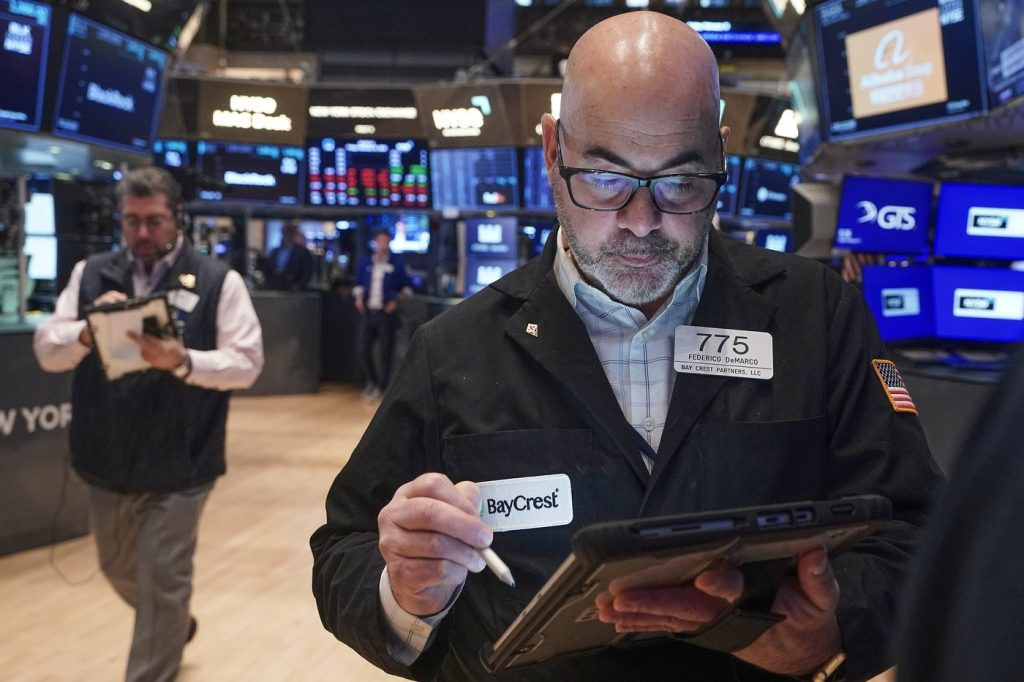
Trader Fred Demarco, right, works on the floor of the New York Stock Exchange, Friday, Feb. 13, 2026, in New York.
Asian markets traded unevenly on Monday as investors prepared for the Lunar New Year break.
Several regional exchanges were either closed or running shortened sessions, which kept overall trading volumes light.
At the same time, gold prices weakened, while oil and currency markets showed only modest movement.
Japan Growth Data Weighs on Tokyo Trading
Japan’s Nikkei 225 slipped slightly after new economic data disappointed investors.
The index fell about 0.2 percent as official figures showed weak quarterly expansion.
Japan’s economy grew at only a 0.2 percent annualized pace in the October–December period.
The slower growth strengthened expectations of fresh government stimulus.
Analysts believe policymakers may increase spending and reduce taxes to support recovery.
Such steps could become central to Tokyo’s economic strategy in coming months.
Holiday Closures Thin Out Regional Activity
Trading across Asia remained unusually quiet ahead of Lunar New Year celebrations.
Markets in mainland China, South Korea, and Taiwan stayed closed for the holiday period.
Because of these closures, regional liquidity dropped and price swings remained limited.
Hong Kong’s Hang Seng Index managed a modest rise during its half-day session.
The index gained roughly 0.5 percent before closing early for the festival break.
Elsewhere, Australia’s S&P/ASX 200 added a small 0.2 percent increase.
India’s BSE Sensex also moved higher, climbing about 0.3 percent.
U.S. Futures Edge Higher Amid Holiday Pause
Wall Street futures showed mild gains even as U.S. markets prepared for closure.
The United States observes Presidents Day, which halted regular stock trading.
Futures tied to the S&P 500 rose about 0.2 percent.
Contracts linked to the Dow Jones Industrial Average also posted similar gains.
Investors continued assessing Friday’s calmer session following earlier volatility.
Markets had dropped previously due to fears about artificial intelligence disrupting industries.
Software and technology firms faced the heaviest selling pressure during that earlier decline.
Inflation Signals Help Calm Wall Street
Fresh U.S. inflation data offered some reassurance to investors.
The report suggested price pressures cooled during the previous month.
This development increased expectations for possible rate cuts by the Federal Reserve.
Lower borrowing costs could support business investment and consumer spending.
That outlook helped stabilize sentiment despite ongoing uncertainty around technology sector changes.
Tech Shares Show Mixed Performance
Technology stocks delivered mixed signals at the end of last week.
Chip giant Nvidia fell more than two percent during Friday trading.
Because of its heavy weighting, the decline influenced broader market movement.
Meanwhile, software firm AppLovin rebounded strongly.
Its shares jumped over six percent after suffering a steep fall one day earlier.
Investors remain focused on how AI developments may reshape future technology profits.
Gold and Silver Prices Move Lower
Precious metals retreated during early Monday commodity trading.
Gold dropped roughly 0.6 percent, reflecting cautious investor positioning.
Silver declined even more sharply, falling nearly two percent.
The pullback came as traders balanced safe-haven demand against stable financial conditions.
With holiday-thinned markets, commodity movements remained relatively contained.
Oil and Currency Markets Stay Steady
Oil prices showed little change despite broader financial uncertainty.
U.S. benchmark crude edged up by just one cent per barrel.
International Brent crude also recorded only a tiny increase.
Currency markets saw the U.S. dollar strengthen slightly against the Japanese yen.
The euro weakened marginally against the dollar during the same period.
Quiet Start to a Holiday-Shortened Week
Overall, Asian shares mixed Lunar New Year trading reflected cautious investor sentiment.
Holiday closures reduced participation across major exchanges throughout the region.
Weak Japanese growth data and global AI concerns added further restraint.
With major markets reopening after the festival period, investors will soon reassess direction.
Upcoming economic data and central bank signals are likely to guide the next market moves.