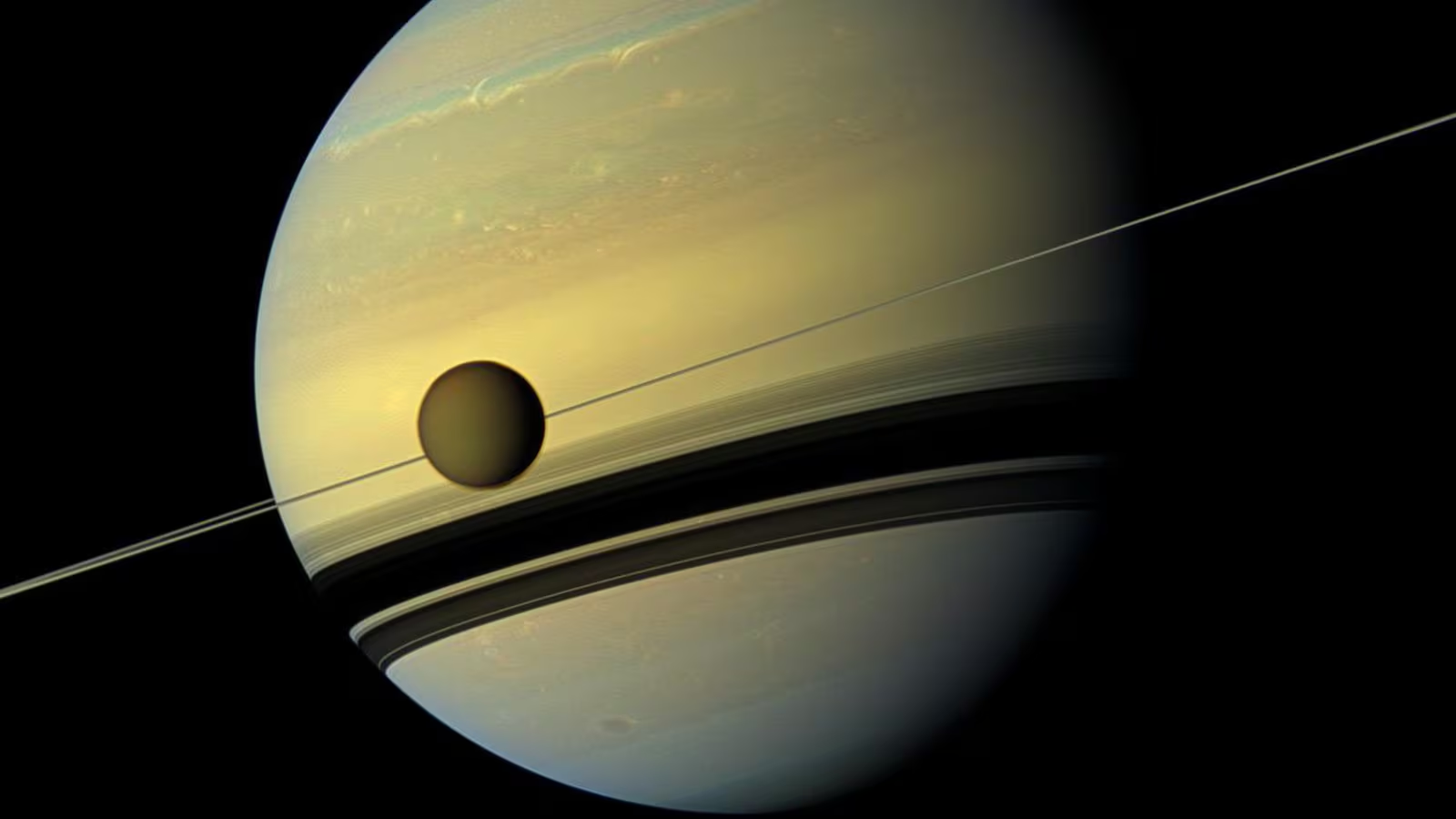
This image shows Saturn and its largest moon, Titan, as seen by the Cassini spacecraft during its mission around the ringed planet. The photo captures Titan orbiting nearby, offering a rare and detailed look at the massive moon alongside Saturn’s distinctive rings. NASA
Saturn’s largest moon, Titan, has long puzzled scientists. Wrapped in thick orange haze and larger than the planet Mercury, Titan stands out as one of the strangest worlds in our solar system. Now, new research offers a bold explanation for how Titan formed — and how Saturn may have gained its famous rings.
Scientists say Titan drifts away from Saturn at a speed of about 11 centimetres a year. That rate surprised researchers. Over millions of years, that slow outward move could eventually send Titan much farther from the planet.
A Crash in the Ancient Past
A research team combined older theories, spacecraft data and computer models to piece together a new story. They suggest that around 500 million years ago, Titan collided with another large moon. That lost moon may have been about half Titan’s size.
Lead researcher Matija Ćuk explained the idea simply: “In this paper, I tried to put all these things together, and I propose that there was an extra moon about half a billion years ago that collided with Titan, that actually became part of Titan.”
According to the study, the crash changed Titan forever. The impact may have added mass to Titan and altered its orbit. It may also explain why Saturn tilts at an angle of 26.7 degrees.
Saturn’s Tilt and the Missing Moon
For years, scientists believed Neptune’s gravity caused Saturn’s tilt. But detailed measurements showed that something did not quite add up. Saturn’s motion did not match what researchers expected.
Ćuk believes the missing piece involves the lost moon. He said, “Right now, Saturn is wobbling a little bit too fast.” He added that if you go back hundreds of millions of years and “add an extra moon, you make it exact. And that explains everything.”
In simple terms, the extra moon may have helped keep Saturn’s motion in sync with Neptune. When that moon disappeared after the crash, the balance changed.
What About Hyperion?
The study also connects the event to Hyperion, one of Saturn’s oddly shaped moons. Hyperion looks like a rough, tumbling rock rather than a smooth sphere. Researchers believe the collision may have created Hyperion as a leftover fragment.
Still, scientists do not yet know whether Hyperion came from Titan’s early form or from the destroyed moon itself.
The Birth of Saturn’s Rings
The crash may also link to Saturn’s bright rings. The team suggests that Titan’s new orbit disturbed smaller inner moons. Those moons may have smashed into one another. Their debris could have spread out and formed the rings hundreds of millions of years later.
Other researchers say the theory makes sense. They note that Saturn’s system looks like it changed over time rather than staying the same since its birth.
Looking Ahead to Dragonfly
Scientists hope a future mission will help confirm the theory. A flying robotic craft called Dragonfly will explore Titan’s surface. It is set to launch in 2028 and reach Titan in the 2030s. By studying Titan’s surface closely, researchers may find clues that support the collision idea.
For now, Saturn’s system still holds mysteries. But this new study brings scientists one step closer to understanding how a giant planet, its drifting moon and its shining rings came to be.