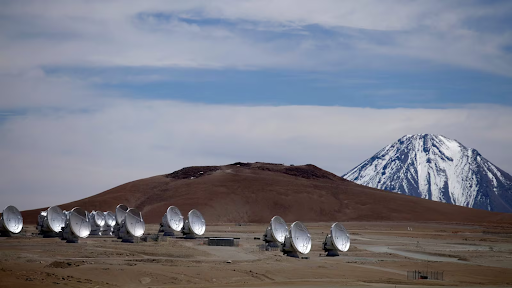
Radio antennas sit across the desert floor at the ALMA observatory site in northern Chile’s Atacama Desert on Sept. 27, 2012. (AP Photo)
A growing group of world-class astronomers calls for urgent action in Chile. They say a large industrial project now planned for the Atacama Desert could harm one of the planet’s most important windows into the universe. Their warning appears in an open letter sent to the Chilean government this week.
The Atacama stands among the darkest regions on Earth. Its extreme dryness, high elevation, clear skies, and distance from city lights give scientists rare views of the cosmos. Many describe it as a vital base for research into galaxies, black holes, planets, and the early universe.
“It’s a perfect cocktail for astronomy,” said Daniela González, executive director of the Skies of Chile Foundation. Her group works to defend the quality of the country’s skies. She says the region helps produce scientific discoveries that reach far beyond Chile.
Concerns Focus on Project Near Paranal Observatory
The controversy centres on a major hydrogen-based energy development proposed near the Paranal Observatory. The site hosts some of the world’s most powerful telescopes, operated by the European Southern Observatory. The facility sits in a location chosen specifically for its natural darkness and steady air.
The letter includes signatures from 30 leading astronomers. One of them is Reinhard Genzel, a Nobel Prize winner whose research on black holes relied on observations from Atacama. The scientists call the project “an imminent threat” to the study of the universe.
They say the development could affect scientific work worldwide. “The damage would extend beyond Chile’s borders,” the letter states. The group argues that research from Paranal guides studies into planet formation, distant galaxies, and the early universe.
“We are convinced that economic development and scientific progress can and must coexist,” the astronomers wrote. “But not at the irreversible expense of one of Earth’s unique and irreplaceable windows to the universe.”
Company Defends Its Plan
AES Andes, the company behind the project, insists its plan will cause no harm. The proposal outlines 3,000 hectares of wind turbines, solar farms, a desalination plant, and a new port. Company officials told reporters that their own studies show the site will follow strict rules on light pollution.
AES Andes says Chile’s environmental safeguards remain strong. The firm argues these protections have guided major projects for decades. The project continues under formal environmental review.
Scientists Warn of Light and Air Disturbance
Astronomers say the risks remain clear. They point to concerns about brighter skies, new dust, ground vibrations, and increased air turbulence that can blur telescope images. The project’s location only three kilometres from Paranal makes the risks especially serious.
“At the best sites in the world for astronomy, stars don’t twinkle,” said Andreas Kaufer, director of operations at ESO. He says even slight artificial turbulence damages the stability needed for high-precision observations. ESO estimates the project could increase local light pollution by 35 per cent.
“If the sky is becoming brighter from artificial light around us, we cannot do these observations anymore,” Kaufer said. “They’re lost.”
A Global Issue Beyond Chile
Chile hosts roughly 40 per cent of the world’s astronomy infrastructure. But experts say this dispute reflects a global trend. More countries face rising conflicts between natural darkness and rapid industrial expansion.
“Major observatories have been chased out to remote locations,” said Ruskin Hartley of DarkSky International. He notes similar pressures in Hawaii, Arizona, and other regions known for scientific work. He says light pollution rises by about 10 per cent each year, leaving fewer places with true night skies.
Advocates say Atacama remains one of the last strongholds of natural darkness. They hope the Chilean government takes steps to protect it.