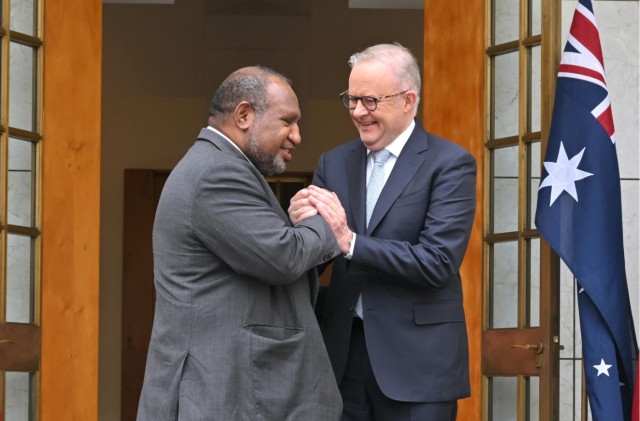
Australia's Prime Minister Antony Albanese, right, shakes hands with Papua New Guinea's Prime minister James Marape after signing the treaty.
Australia and Papua New Guinea have signed a landmark defense treaty that is already drawing China’s attention. The agreement, hailed as historic, strengthens regional security ties while raising questions about its wider impact in the Pacific.
A New Era in Defense Ties
Australian Prime Minister Anthony Albanese and Papua New Guinea’s James Marape signed the treaty on Monday. Both leaders called it a mutual defense pact designed to integrate their armed forces and deepen military cooperation.
The treaty is significant for both nations. For Australia, it is only the second alliance-level pact after the ANZUS Treaty with the United States and New Zealand in 1951. For Papua New Guinea, it marks the first major defense agreement in its history.
The treaty will officially take effect once ratified by both parliaments.
Albanese Calls It a Privilege
Albanese described the partnership as a privilege. “It is a great honor for Australia to have its nearest neighbor become our newest ally,” he said at a joint press conference.
He emphasized that the pact mirrors commitments under the ANZUS Treaty. “If either country faces an armed attack, both will act to meet the common danger,” Albanese explained. He further noted that both nations agreed not to pursue activities that could undermine the agreement.
China Voices Concern
The treaty has not gone unnoticed by Beijing. After an earlier joint statement supporting the treaty’s principles, China’s embassy in Papua New Guinea raised concerns.
In a statement, the embassy urged that “such agreements should not be exclusive, nor should they prevent cooperation with third parties.” It further stressed that defense pacts “should not target any third party or undermine its legitimate interests.”
China’s growing role in the Pacific has heightened sensitivities around such security arrangements.
Marape Stresses Balance
Prime Minister Marape responded by clarifying that the treaty aligns with Papua New Guinea’s long-standing foreign policy: “friends to all, enemy to none.”
He rejected the idea that the deal creates new rivalries. “This is not about enemies. This treaty consolidates our friendship with Australia. We have been transparent with China, and they understand,” Marape said.
He added that the treaty secures Papua New Guinea’s defense cooperation “with no intent of creating hostility elsewhere.”
Strategic Importance in the Pacific
Papua New Guinea has become an important partner for both the United States and Australia. The island nation sits in a key strategic location as Western allies seek to counter China’s expanding influence in the Pacific.
Australia has been especially active in reinforcing ties with Pacific nations since 2022. That year, China signed a controversial security pact with the Solomon Islands, sparking concerns about a possible Chinese naval base in the region.
Growing Competition in the Region
Beyond Australia and New Zealand, only Papua New Guinea, Fiji, and Tonga maintain standing militaries in the Pacific. Australia is currently negotiating another bilateral defense treaty with Fiji.
Meanwhile, China’s influence continues to expand. Since 2019, three Pacific nations have switched diplomatic recognition from Taiwan to Beijing. China has also extended its reach through police training programs in Fiji, Samoa, Kiribati, Solomon Islands, and Vanuatu.
Looking Ahead
The Australia–Papua New Guinea defense treaty is more than just a bilateral pact. It signals a shift in regional security dynamics and highlights the Pacific’s growing role in global geopolitics.
For Papua New Guinea, it strengthens its defense ties with Australia while leaving room for economic partnerships with China. For Australia, it reaffirms its role as a key security partner in the Pacific.
As both countries move toward ratification, the treaty will continue to draw global attention—especially from Beijing.