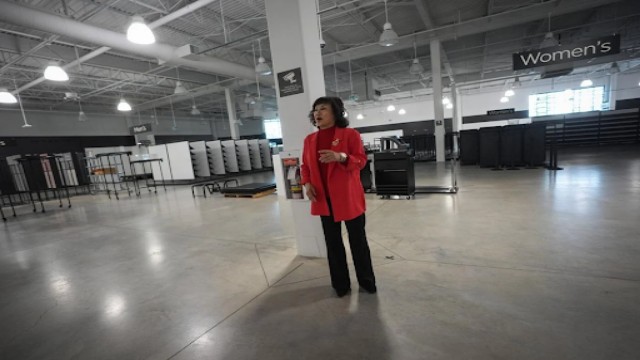
On Thursday, June 26, 2025, billionaire Ruby Liu visited the former Saks Off 5th store at Tsawwassen Mills mall in Tsawwassen, B.C., after a brief ceremony where she was handed the keys to the property she now owns. The space was previously operated by Hudson’s Bay. THE CANADIAN PRESS/Darryl Dyck
A group of Canada’s top real estate companies is fighting to block B.C. billionaire Ruby Liu’s bid to take over 25 former Hudson’s Bay store leases, calling her vision “unrealistic” and lacking in commercial sense.
Cadillac Fairview, Oxford Properties, Ivanhoe Cambridge, KingSett Capital, Morguard Investments, and Primaris REIT filed court documents urging the Ontario Superior Court to stop Liu from moving into the prized retail locations.
The landlords say Liu has no credible business strategy, insufficient experience, and inadequate resources to manage such a large-scale retail operation. Despite owning three B.C. shopping centres, they argue her proposed stores are an “empty shell” with no financial safety net beyond her claims.
Dispute Over Prime Retail Spaces
This legal clash began after Hudson’s Bay, struggling under heavy debt, filed for creditor protection in March. In May, the company agreed to sell 28 of its leases to Liu. Three leases were quickly approved—those tied to malls she already owns—but the remaining 25, covering prime, low-rent anchor spots, hit resistance from landlords.
Hudson’s Bay has since asked the court to force property owners to accept Liu as the new tenant. A hearing is set for the end of the month, with Liu and the Bay expected to respond by Tuesday.
Liu’s Big Vision Meets Lease Restrictions
Liu aims to transform the Bay spaces into department stores under her own brand, offering retail alongside dining, entertainment, children’s play areas, and even grocery and educational facilities. Landlords counter that these ideas violate existing lease terms, which permit only department store operations.
Oxford executives say Liu’s proposals—including luxury Asian dining at certain locations—conflict with spaces already operated by the landlords, such as mall food courts.
Financial and Operational Doubts
Liu has pledged $120 million for urgent repairs and $135 million for opening inventory, claiming she can launch at least 20 stores within 180 days. But Cadillac Fairview calls this timeline “entirely unrealistic,” estimating far higher repair costs—over $43 million for its properties alone within a decade.
Oxford also disputes her renovation budgets, alleging Liu was unaware she’d be responsible for major structural upkeep like roofs. Questions also surround her inventory supply, as court evidence shows only letters from vendors expressing willingness, not firm commitments.
Staffing plans are another concern. Liu projects 1,800 employees across 28 stores, which landlords argue would leave too few workers per location to run a large retail chain effectively.
Fears of Future Vacancies
Landlords warn that if Liu’s venture fails, the fallout could damage mall traffic and revenues for years. Some executives believe redeveloping the spaces after a failure could be costlier than preventing her from taking over in the first place.
The court’s decision later this month could shape the future of some of Canada’s most sought-after retail real estate.