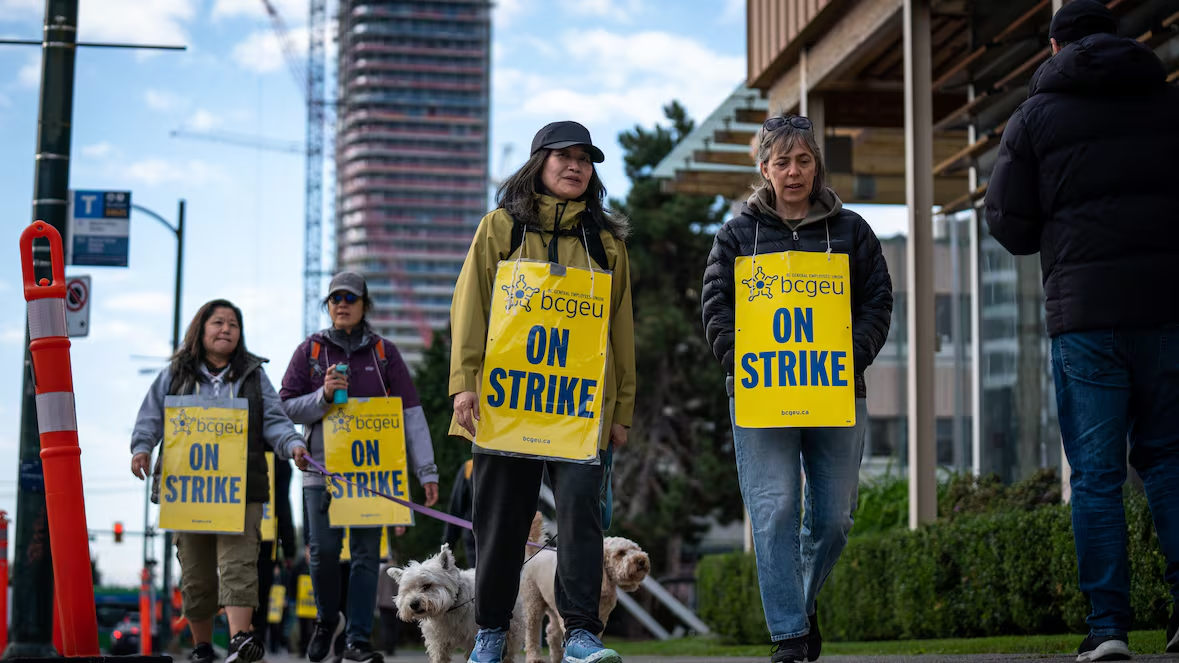
BCGEU members are seen picketing outside a B.C. Liquor Store in Vancouver on October 3. The union has now announced a tentative agreement that could bring an end to the eight-week strike. CBC
The long-running strike involving thousands of British Columbia public service workers may soon end. The B.C. General Employees’ Union (BCGEU) announced a tentative agreement with the provincial government on Sunday after weeks of tough negotiations. The Professional Employees Association (PEA) also said it would remove picket lines and return to the bargaining table.
More than 25,000 BCGEU members and 1,600 PEA workers began job action on September 2. The strike disrupted key services, including liquor distribution, driver licensing, and even wildfire response. But with this new deal, both unions plan to send members back to work Monday while ratification votes move forward.
Tentative Deal Reached After Mediation
The BCGEU confirmed that the deal includes a general wage increase of three per cent per year for the next four years. Mediated talks with government negotiators produced the agreement early Sunday morning.
BCGEU president Paul Finch said he was thrilled with the outcome after eight weeks of picketing. “This comes after a very hard-fought victory for our members — and really, broadly, for working people in B.C.,” Finch said.
The union described the deal as “significant progress” on wages, affordability, and working conditions. Members will receive details this week, with ratification voting expected to start soon. A simple majority is needed to approve the deal.
Impact of the Strike
The strike affected a wide range of government operations. Many B.C. Liquor Stores and distribution centres closed, causing shortages of alcohol and cannabis across the province. Other services — such as student loan processing, IVF funding programs, and correctional operations — also faced disruptions.
The agreement includes improvements to remote work arrangements and specific pay increases for lower-wage public servants. Finch said these measures will make a meaningful difference for workers struggling with rising living costs.
Government Response
Finance Minister Brenda Bailey welcomed the tentative deal but said she would reserve further comments until after the union vote. “Our government respects the ratification process and the rights of union members to vote,” she said in a statement.
Premier David Eby previously said the strike had “gone on too long” and expressed hope that mediation would lead to a fair and quick resolution. Labour mediator Vince Ready, a veteran negotiator, led the talks alongside Amanda Rogers.
Broader Implications
Experts say the BCGEU deal could influence future union negotiations across the province. David Hannah, a professor at Simon Fraser University, said the four-year agreement gives both sides stability before the next provincial election. “The government gets security for four years, and the union gets a fair raise and predictability,” he explained.
PEA Returns to Talks
The PEA, which represents lawyers, engineers, pharmacists, and other professionals, announced it would suspend picket lines and resume talks with the province. Executive director Melissa Moroz said the union made progress on several key priorities and would continue negotiations in good faith.
Both unions’ decisions mark a turning point after nearly two months of labour unrest. If ratified, the agreement could restore normal operations across B.C.’s public sector within weeks.