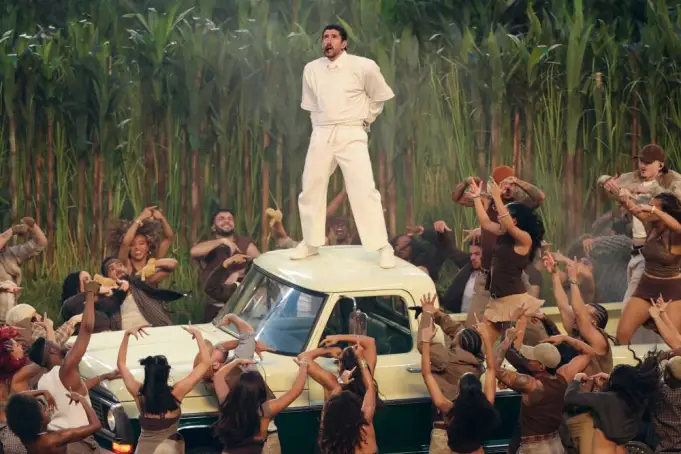
Bad Bunny is seen performing on the car.
Bad Bunny delivered a Super Bowl halftime performance that felt less like a concert and more like a cultural moment.
In front of more than 125 million viewers, the global superstar transformed the stage into a joyful celebration of Latin identity, unity, and resilience.
The artist had promised the world would dance, and he kept that promise with confidence and clarity.
From the opening seconds, the Bad Bunny Super Bowl halftime show blended music, symbolism, and emotion into a seamless narrative.
A Stage Rooted in Puerto Rican Life
The performance was deeply inspired by Puerto Rico, Bad Bunny’s homeland.
The elaborate set recreated familiar neighborhood scenes, including a sugar-cane field and a traditional vecindad.
Viewers saw a barber shop, a liquor store, and the iconic casita that fans recognized from his recent residency.
These visuals grounded the show in everyday island life while elevating it onto the world’s biggest stage.
As the performance unfolded, the set transformed smoothly into a massive dance floor.
The transition mirrored Bad Bunny’s journey from local roots to global influence.
A Crowd That Reflected Latino Unity
Celebrities filled the stage, not as distractions, but as participants in the celebration.
Karol G, Cardi B, Jessica Alba, Young Miko, and Pedro Pascal were seen dancing under the casita roof.
Their presence reinforced a central message of togetherness and shared identity.
The Bad Bunny Super Bowl halftime show felt communal rather than individualistic.
Fans quickly noticed countless hidden references layered throughout the performance.
These Easter eggs ranged from cultural nods to political statements that invited deeper reflection.
Lady Gaga Joins for a Symbolic Wedding
Midway through the show, Lady Gaga emerged in one of the night’s most striking moments.
She performed a salsa-inspired version of “Die With a Smile,” reimagined through a Latin lens.
The performance doubled as a symbolic wedding ceremony, complete with live dancers and musicians.
Bad Bunny later joined Gaga for a joyful dance that celebrated artistic collaboration without borders.
The moment stood out as a powerful exchange between global pop and Latin music traditions.
It reinforced the show’s core theme of unity through shared culture.
Ricky Martin Brings Reflection and History
Ricky Martin’s appearance added emotional depth to the performance.
Seated beside an empty chair, he sang as dancers reenacted a blackout caused by Hurricane Maria.
The imagery referenced the long months Puerto Rico spent without electricity in 2017.
The empty chair appeared to honor the thousands of lives lost during the disaster.
Bad Bunny soon returned to perform “El Apagón” alongside Martin.
The collaboration linked past and present voices of Puerto Rican music on a historic stage.
Politics Woven Into Performance
Political symbolism surfaced without overpowering the music.
A replay of Bad Bunny’s recent Grammy speech appeared on a small television during the show.
A young boy resembling a child recently detained by immigration authorities stood nearby.
Bad Bunny handed him a Grammy, creating one of the night’s most talked-about moments.
Before the game, protesters gathered outside the stadium holding anti-ICE signs.
Their presence echoed the performance’s underlying messages about compassion and dignity.
A Finale Focused on Love and Belonging
As the show neared its end, dancers waved flags representing countries across the Americas.
Bad Bunny held a football bearing the message, “Together, we are America.”
He closed by blessing every nation in the Americas, including Puerto Rico.
Behind him, a billboard read, “The only thing more powerful than hate is love.”
Fireworks followed as the field turned into a massive dance party.
The Bad Bunny Super Bowl halftime show ended as it began, with joy and movement.
Beyond its spectacle, the performance made history as the first primarily Spanish-language halftime show.
More importantly, it delivered a clear message that culture is meant to be shared, not divided.