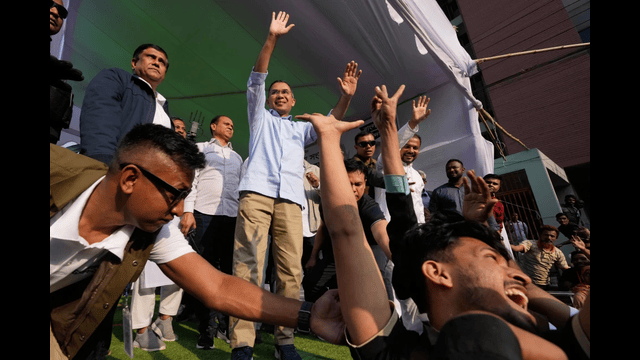
Tarique Rahman, the son of former Prime Minister Khaleda Zia and chairman of the Bangladesh Nationalist Party(BNP), attends an election rally ahead of the national election in Dhaka.
Bangladesh is heading into a defining national election shaped by upheaval, uncertainty, and cautious public hope.
The vote marks the country’s first nationwide poll since the violent student-led uprising of 2024.
For many citizens, the Bangladesh election represents both a rare opportunity and a serious test of democracy.
The return of Tarique Rahman has added momentum to an already volatile political moment.
After 17 years in exile, the son of former Prime Minister Khaleda Zia came back in December.
His arrival coincided with an interim administration struggling to steady the country ahead of elections.
Rahman’s reappearance was widely seen as symbolic.
His longtime rival, former Prime Minister Sheikh Hasina, will not contest the election.
Her removal during last year’s unrest ended more than a decade of tightly controlled rule.
Rahman Emerges as a Central Figure
Within weeks of returning, Rahman positioned himself as a leading contender.
At a recent rally in Dhaka, he arrived under heavy security to loud cheers.
Supporters filled a public park, dancing as he outlined his political vision.
Rahman told the crowd his goal was to change the nation’s destiny.
He promised jobs, free speech, stronger law enforcement, and action against corruption.
His campaign frames him as a defender of democratic values in a damaged political system.
Although Rahman never held public office, his influence was long felt within the Bangladesh Nationalist Party.
Many voters remember his behind-the-scenes role during his mother’s time in power.
That history both strengthens his support and fuels skepticism among critics.
A Polarized and Risky Contest
The Bangladesh election is shaping into a two-way contest.
Rahman’s BNP faces an alliance led by Jamaat-e-Islami, the country’s largest Islamist party.
The coalition includes 11 parties united by calls for political renewal.
Jamaat-e-Islami has sought to rebrand itself.
At a rally this week, party leader Shafiqur Rahman spoke of building a new Bangladesh.
Yet its past collaboration with Pakistan during the 1971 war still casts a long shadow.
Concerns have also grown over the party’s social views.
Statements suggesting limits on women’s work have unsettled many voters.
Rights groups fear a rollback of hard-won freedoms if the alliance gains power.
Democracy Still Under Strain
Observers warn that a peaceful Bangladesh election alone will not restore democracy.
The country has endured years of disputed votes, shrinking political space, and weakened institutions.
Violence, religious intolerance, and attacks on journalists have deepened public anxiety.
Thomas Kean of the International Crisis Group said a credible vote would be meaningful progress.
However, he cautioned that rebuilding democratic norms will take sustained effort.
According to Kean, the recovery process has only just begun.
Disillusionment Among Uprising Veterans
Some who led the 2024 uprising feel disappointed by political developments since then.
Initial optimism followed Nobel laureate Muhammad Yunus taking interim leadership.
That hope faded when student leaders aligned with Jamaat-e-Islami.
Tasnim Jara, a former member of the National Citizen Party, chose to run independently.
She said the alliance made genuine reform difficult to imagine.
For her, the promise of a new political culture slipped away.
University student Arafat Imran shares similar doubts.
He believes the uprising brought new faces but not systemic change.
Institutions like the military and bureaucracy, he said, remain untouched.
Press Freedom Raises Alarm
Concerns about democracy extend to media freedom.
Journalists who spoke out during the uprising now report threats and intimidation.
Several media outlets have been attacked or forced to close temporarily.
Talk-show host Roksana Anzuman Nicole says her hopes collapsed quickly.
After challenging mob violence on air, she received threats and went off-screen.
Others have lost jobs after being labeled collaborators of the former regime.
Human rights groups say press freedom is deteriorating.
They warn that silencing journalists undermines the credibility of the Bangladesh election.
Protecting free expression, they argue, is essential for democratic recovery.
A Vote Filled With Hope and Uncertainty
The election will also include a referendum on political reforms.
Proposals include term limits and stronger checks on executive power.
Many voters see these measures as overdue.
Still, uncertainty dominates the national mood.
Analysts say this may be the first fair vote in 16 years.
Yet lasting change will depend on deeper cultural and institutional reform.
As Bangladesh heads to the polls, expectations remain cautious.
The Bangladesh election offers a rare chance to reset democracy.
Whether that chance is realized remains an open question.