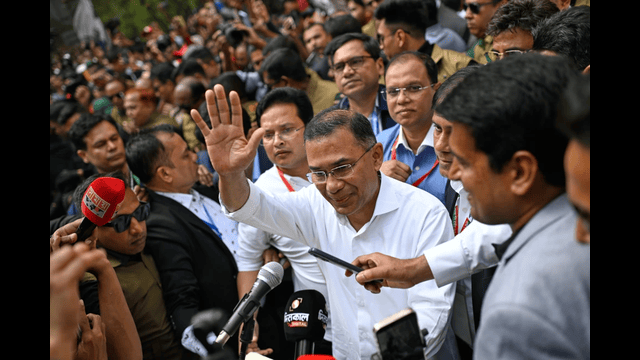
Bangladesh Nationalist Party Chairperson Tarique Rahman waves as he comes out after casting his vote during the national parliamentary elections in Dhaka.
The Bangladesh Nationalist Party has declared victory in the country’s first national vote since the 2024 uprising. The result signals a dramatic shift in Bangladesh’s political direction after years of unrest and disputed elections. While official confirmation is pending, local reports suggest the party has secured a parliamentary majority.
The Bangladesh Nationalist Party claims it has crossed the required 151-seat threshold in the 350-member Parliament. That figure includes 50 reserved seats for women, allocated proportionally among winning parties. If confirmed, the party will form the next government without coalition support.
Leadership Returns After Years in Exile
At the center of the Bangladesh Nationalist Party victory is Tarique Rahman, the party’s prime ministerial candidate. The 60-year-old leader returned to Bangladesh in December after 17 years in London exile. His return followed the collapse of the previous government amid mass protests.
Rahman is the son of former Prime Minister Khaleda Zia, who died in December. For years, he denied corruption charges filed under the previous administration, calling them politically motivated. Those cases were dropped after the 2024 uprising, clearing his path back into active politics.
Senior party leader Ruhul Kabir Rizvi congratulated voters for supporting the Bangladesh Nationalist Party. Meanwhile, Rahman urged supporters to avoid public celebrations and instead offer prayers during Friday services. The call aimed to maintain calm during a sensitive political transition.
International Leaders Respond Quickly
Global reactions followed swiftly after the Bangladesh Nationalist Party victory announcement. The U.S. Embassy in Dhaka described the outcome as historic and expressed readiness to strengthen bilateral ties. Ambassador Brent T. Christensen emphasized cooperation on shared prosperity and security goals.
Indian Prime Minister Narendra Modi also extended congratulations, noting the confidence voters placed in Rahman’s leadership. He expressed hope for deeper collaboration between the two neighboring nations. Pakistan’s President Asif Ali Zardari echoed similar sentiments, pledging continued democratic partnership.
Bangladesh’s relationships with India and Pakistan have long been complex. India supported Bangladesh’s independence in 1971 and maintained warm ties under former Prime Minister Sheikh Hasina. Pakistan’s influence had diminished under Hasina but regained space under the interim administration.
Islamist Alliance Emerges as Strong Opposition
Although the Bangladesh Nationalist Party appears set to govern, the Islamist Jamaat-e-Islami-led alliance made significant gains. The coalition reportedly secured at least 77 seats, positioning itself as the main opposition bloc.
Jamaat chief Shafiqur Rahman won a seat in Dhaka and is expected to lead the opposition in Parliament. However, party officials questioned delays in announcing results in certain constituencies. They alleged irregularities, claiming some alliance candidates narrowly lost under suspicious circumstances.
The National Citizen Party, formed by student leaders from the 2024 uprising, also secured representation. Several of its senior leaders won seats after aligning with the Islamist coalition. Their presence signals evolving political alliances following the protests.
A Crucial Test for Democracy
This election marked a pivotal moment for Bangladesh’s democratic future. It was the first vote since the violent student-led revolt that ousted Sheikh Hasina in July 2024. Many observers saw it as a test of whether public protests could lead to lasting political reform.
Voting occurred under heavy security amid fears of unrest and democratic backsliding. Alongside the election, citizens participated in a referendum proposing reforms such as term limits for the prime minister. Results of the referendum remain pending but are expected to pass.
Pressure Mounts on the New Government
Despite its apparent win, the Bangladesh Nationalist Party faces high expectations. Analysts note that the party has historically been linked to dynastic politics and corruption allegations. Its leadership lineage traces back to Ziaur Rahman, Bangladesh’s sixth president.
Political observers argue the party must now demonstrate reform-minded governance. Michael Kugelman of the Atlantic Council described the outcome as complex, suggesting the party must adapt to public demands for accountability.
The Bangladesh Nationalist Party victory represents both continuity and change in Bangladesh’s political story. As the nation awaits official confirmation, attention shifts to how the new government will address democratic reforms and national unity.