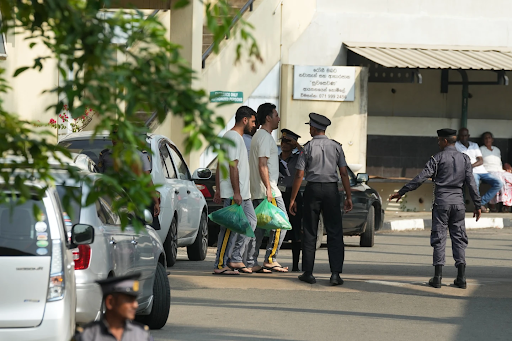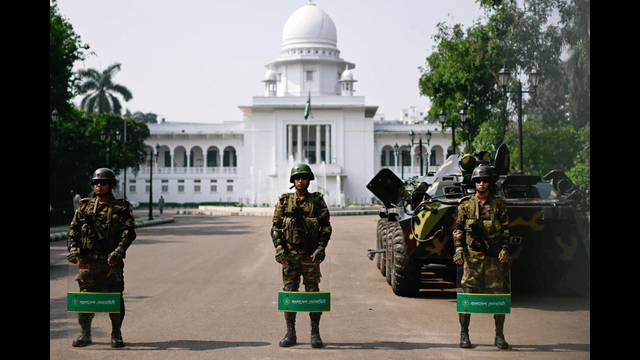
Security personnel stand guard at the Bangladesh Supreme Court.
Bangladesh entered a tense week on Monday as security forces tightened their grip on Dhaka and several other districts. The heightened alert came ahead of the expected verdict against ousted Prime Minister Sheikh Hasina, who is being tried on crimes against humanity charges linked to the 2024 uprising that ended her 15-year rule.
Security on High Alert Across Bangladesh
Paramilitary border guards, riot police, and special forces were deployed across major cities. Authorities reinforced checkpoints, monitored key intersections, and increased surveillance around government buildings.
The move followed a nationwide shutdown called by Hasina’s Awami League, which labeled the tribunal a “kangaroo court.” Roads in Dhaka remained largely empty as transport operators suspended services amid fears of violence.
Tribunal Prepares Verdict in High-Stakes Trial
A special tribunal is expected to announce its verdict against Sheikh Hasina, former Home Minister Asaduzzaman Khan, and former police chief Benazir Ahmed.
Prosecutors have sought the death penalty for Hasina and Khan, both of whom are believed to be in India. Ahmed, who became a state witness and pleaded guilty, may avoid punishment.
The tribunal’s decision follows months of hearings conducted without the presence of Hasina or Khan, who are being tried in absentia.
Charges Stem From Deadly 2024 Uprising
The trial centers on the student-led uprising of July–August 2024. The unrest forced Hasina from power and triggered widespread violence.
The United Nations estimated up to 1,400 deaths during the turmoil. Bangladesh’s own interim government reported more than 800 killed and 14,000 injured.
The nation’s streets descended into chaos during those weeks, leading to Hasina’s dramatic ouster on August 5, followed by her flight to India.
Tensions Rise as Explosions and Arson Intensify
As the verdict approached, Bangladesh witnessed a resurgence of unrest. Crude bomb explosions were reported across Dhaka, including outside the residence of a senior government adviser on Sunday.
Nearly 50 arson attacks have taken place in one week, most targeting vehicles. Two people have died in these attacks, prompting authorities to adopt severe countermeasures.
Dhaka police chief Sheikh Mohammad Sazzat Ali issued a shoot-on-sight order against anyone attempting arson or carrying explosives.
Hasina Urges Calm but Rejects Tribunal’s Legitimacy
Despite being exiled, Hasina addressed supporters in an audio message, telling them not to feel “nervous” about the verdict. She denounced the tribunal as illegitimate and criticized the state-appointed lawyer assigned to her.
Hasina, who has survived at least 19 assassination attempts since 1981, remains a polarizing figure. Her supporters describe the tribunal as politically motivated.
Interim Government Seeks to Consolidate Control
Following Hasina’s fall, Nobel laureate Muhammad Yunus assumed leadership of the interim government. He pledged to punish Hasina, banned her Awami League party, and accused her of enabling mass violence.
Yunus announced plans to hold national elections in February. However, the Awami League will not be allowed to contest, deepening concerns about democratic rollback.
Bangladesh’s political climate under Yunus remains highly unstable, with growing divisions and minimal signs of long-term resolution.
Military Requested to Secure Tribunal
In anticipation of unrest, Supreme Court authorities officially requested army deployment around the tribunal premises. The prosecution also suggested broadcasting the verdict live on national television to ensure transparency.
However, the call for military presence underscores the deep insecurity haunting the country as it awaits a defining legal and political outcome.
Bangladesh at a Crossroads as Verdict Looms
As the nation braces for the verdict against Sheikh Hasina, tensions remain high, streets stay volatile, and political divisions widen.
The verdict could shape Bangladesh’s political direction for years—either by reinforcing the interim government’s authority or igniting further unrest among millions of Hasina’s followers.
For now, Bangladesh stands at a crossroads, navigating uncertainty amid intensifying pressure from both political camps and the growing fear of renewed violence.