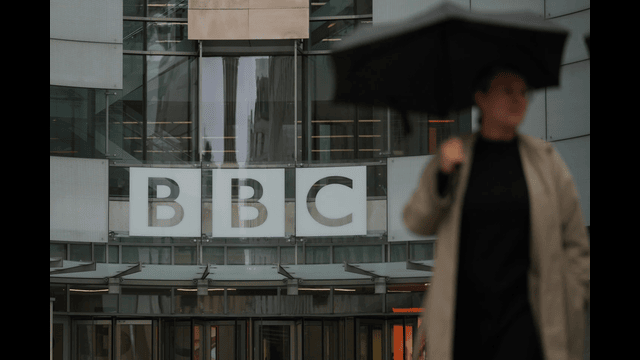
A man walks outside the BBC Headquarters in London, Monday, Nov. 10, 2025.
The BBC is facing one of its toughest storms yet after the editing of a Donald Trump speech sparked public outrage, political attacks, and the resignation of two top executives. The incident has reignited old accusations of bias and raised questions about the broadcaster’s future credibility and independence.
BBC Faces Fallout Over Trump Speech
The controversy erupted after the BBC’s flagship “Panorama” program allegedly misrepresented Trump’s January 6, 2021 speech by splicing together separate parts of his address. The edit made it appear as if Trump explicitly urged his supporters to march on Capitol Hill and “fight like hell.”
Crucially, the segment that followed — in which Trump urged his followers to protest peacefully — was omitted.
The revelation led to furious backlash, especially after the Daily Telegraph published details from an internal memo that flagged the misleading edit. The memo, written by a former editorial standards adviser, accused the BBC of poor judgment and implied a breach of impartiality standards.
Executives Step Down Amid Growing Pressure
The fallout was immediate. Director-General Tim Davie and Head of News Deborah Turness resigned on Sunday, citing accountability for the editorial failure.
BBC Chair Samir Shah admitted that the edit gave “the impression of a direct call for violent action,” calling it an “error of judgment.”
Turness later stated that the mistake was “serious but not intentional” and firmly denied any institutional bias, a stance echoed by U.K. Prime Minister Keir Starmer, who defended the BBC as an essential, impartial public service.
Trump Threatens Legal Action
Meanwhile, former U.S. President Donald Trump has threatened to sue the BBC. His lawyer sent a formal notice demanding a full retraction, compensation, and an apology for what they called “false and defamatory editing.”
This isn’t Trump’s first legal battle with media outlets. In recent years, he has filed multiple defamation lawsuits against major networks, including CBS and ABC News, both of which settled for millions.
Trump celebrated the BBC scandal on social media, calling its journalists “corrupt and dishonest” and accusing the network of trying to influence the 2024 U.S. election.
Longstanding Bias Allegations Resurface
For years, the BBC has faced accusations of political bias — often from both sides of the spectrum. Critics on the right argue that it leans liberal and metropolitan, while others claim it is too cautious toward Conservative governments.
The latest memo also criticized BBC’s reporting on transgender issues and the Israel-Hamas conflict, accusing it of promoting a “pro-trans” and “anti-Israel” agenda.
Former Daily Telegraph editor Charles Moore claimed the network’s tone “always reflects a left-leaning worldview,” while right-wing leader Nigel Farage declared that the BBC has been “institutionally biased for decades.”
In contrast, journalism professor Julie Posetti called the current backlash part of a larger political effort to undermine public broadcasters, warning that the BBC’s quick capitulation could have a “destabilizing effect.”
Funding Model and Future Uncertainty
The BBC’s credibility crisis comes at a delicate time. Funded by a £174.50 ($230) annual license fee paid by British households, the broadcaster must renew its charter in the next few years. Critics argue the traditional funding model is unsustainable in the age of streaming and social media.
Nicknamed “Auntie,” the century-old institution remains a symbol of British culture, known for both global journalism and entertainment staples like Doctor Who and Strictly Come Dancing. Its World Service, broadcasting in 40+ languages, still commands huge international respect.
But with declining revenues, internal dissent, and growing political scrutiny, experts warn the BBC’s future may hang in the balance.
“An Existential Crisis” for the BBC
Media experts are calling the scandal an “existential crisis.” Posetti cautioned that by yielding so quickly to political pressure, the BBC risks becoming vulnerable to intimidation in an already polarized world.
“The information ecosystem is deeply polluted,” she said. “Public broadcasters like the BBC are more important than ever — but only if they stand firm.”