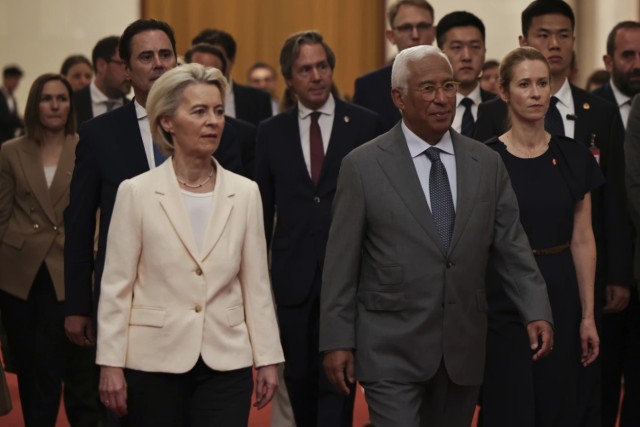
Left to right, European Commission President Ursula von der Leyen, European Council President Antonio Costa, and European Union’s foreign policy chief, Kaja Kallas walk at the Great Hall of the People before the European Union- China Summit in Beijing, China, Thursday, July 24, 2025.
European leaders, during a one-day summit in Beijing, urged China to reset trade relations and address imbalances straining their partnership. The talks, initially planned for two days, were scaled down to one, but key issues remained on the table—from trade deficits to geopolitical concerns.
Trade Tensions Dominate the Agenda
EU leaders opened with strong appeals to China for more balanced trade. European Commission President Ursula von der Leyen said the partnership had reached “an inflection point.” She stressed that relations must be “mutually beneficial” to be sustainable.
The European Union faces a massive trade deficit with China, estimated at €300 billion last year. While China remains the EU’s second-largest trade partner, this growing gap has sparked unease across member states.
European Council President António Costa echoed concerns and called for “concrete progress.” Both leaders emphasized that the economic relationship needs urgent rebalancing.
Electric Vehicles and Critical Minerals Spark Disputes
One major flashpoint is the electric vehicle (EV) industry. The EU recently imposed tariffs on Chinese EVs to counter China’s heavy subsidies, aiming to protect its own auto sector. EU industries fear that a surge of cheap Chinese EVs could undercut green technology development and threaten millions of European jobs.
China, in return, has launched investigations into EU food exports like pork and dairy. Tariffs on French spirits and tighter rules on EU medical devices have also raised tensions.
The EU hit back in June by excluding Chinese medical suppliers from public tenders over €5 million. Brussels cited unfair restrictions on European companies in China’s procurement market as justification.
Security, Human Rights, and Cyber Threats on the Table
Trade wasn’t the only focus. European leaders brought up cyberattacks, espionage, and human rights violations in regions like Xinjiang, Hong Kong, and Tibet.
Although China recently suspended sanctions on some European lawmakers, its overall stance has hardened. Analysts suggest Beijing is less inclined to make concessions after weathering past U.S. trade pressure.
Despite symbolic gestures, like China’s suspension of sanctions, distrust remains high. The EU continues to criticize China’s restrictive policies and authoritarian practices.
Ukraine War Adds to Diplomatic Strains
Europe also used the summit to press China on its relationship with Russia. Costa asked China to leverage its influence over Moscow and help end the war in Ukraine.
However, China has remained close to Russia, becoming a top buyer of Russian energy and a supplier of technology amidst Western sanctions. Chinese banks recently faced EU penalties for alleged links to Russia’s war efforts—sanctions Beijing firmly rejected.
Despite these concerns, President Xi Jinping reiterated calls for cooperation. He urged the EU to "seek common ground" and deepen mutual trust. But European leaders remain skeptical of China’s real intentions.
EU Looks Beyond China and the U.S.
Caught between an aggressive Washington and a firm Beijing, Europe is broadening its global alliances. Trade agreements with Indonesia, Mexico, and South America are in the works. Japan, a key partner, is also rising in importance.
On a visit to Tokyo, Von der Leyen said, “87% of global trade is with others. Many are looking for stability.” She described Europe and Japan as like-minded partners ready to resist rising protectionism and defend shared values.
Japan has made EU ties a key part of its 2025 defense policy, alongside its alliances with the U.S. and domestic defense upgrades.
A Summit with Limited Gains
Despite deep economic ties and shared climate goals, EU-China relations remain strained. From EVs and rare earth minerals to human rights and Russia, disagreements run deep.
While Europe holds leverage as China’s top export market, Beijing’s hardened approach shows little sign of change. With global instability rising, the EU’s push for a fairer, safer trade relationship with China continues—but real progress may take more than a day’s summit.