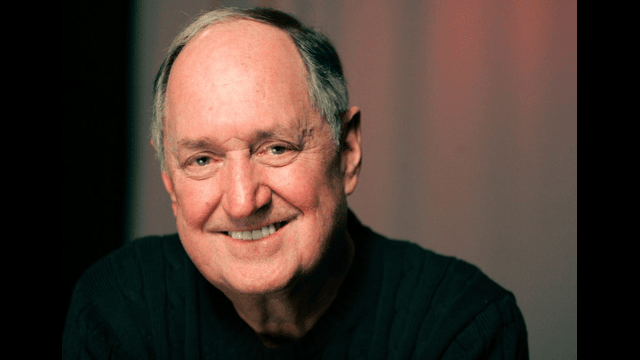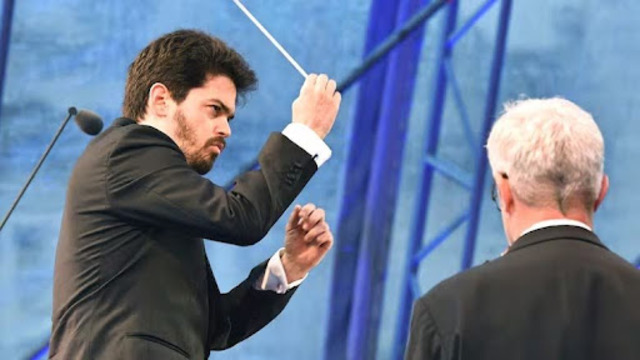
Israeli-born conductor Lahav Shani led the Vienna Symphony Orchestra during the Festival of Joy concert outside Vienna’s Hofburg Palace on May 8, 2018. (Getty images)
A Belgian classical music festival has triggered a storm of criticism after cancelling a major performance led by Israeli conductor Lahav Shani. The move, linked to the ongoing war in Gaza, has drawn condemnation from politicians and artists across Europe.
The Flanders Festival Ghent, one of Europe’s most prestigious classical events, announced it was cancelling the Sept. 18 concert by the Munich Philharmonic Orchestra. The reason cited: concerns over Shani’s association with Israel and uncertainty about his stance on the conflict.
Shani, born in Tel Aviv, is the director of the Israel Philharmonic Orchestra and set to become the chief conductor of the Munich Philharmonic next year. He had been scheduled to lead the orchestra’s performance in Ghent, billed as a highlight of the three-week festival that attracts more than 50,000 visitors annually.
Festival’s Justification
Organizers admitted the decision came despite Shani previously calling for “peace and reconciliation.” Their statement argued that his role with the Israel Philharmonic left “insufficient clarity” about his position on what they described as “the genocidal regime in Tel Aviv.”
The festival added it would not work with partners “who have not distanced themselves unequivocally” from that regime.
Artistic director Joost Fonteyne later defended the move, stressing it was not antisemitic but a response to what organizers viewed as moral ambiguity. “Genocide leaves no room for ambiguity,” he told reporters. “We did not proceed lightly.”
Backlash Across Europe
The cancellation has been met with widespread outrage. The Israeli Philharmonic condemned the decision, calling it discriminatory. “In the world of music and art, there is simply no place for withdrawing an invitation based on one’s place of origin,” it said.
Belgium’s Prime Minister Bart De Wever also denounced the festival, saying it had caused “severe damage” to the country’s reputation. “To impose a professional ban on someone solely because of their origin is both reckless and irresponsible,” he wrote.
Flanders region minister-president Matthias Diependaele echoed the criticism, arguing art should “build bridges, not walls.” He acknowledged the festival’s intent to send a political signal but insisted such action should not come at the expense of an individual artist.
Germany, too, reacted sharply. Bavarian minister of state for science and the arts Markus Blume labelled the decision “shameful, anti-cultural, and scandalous.” Wolfram Weimer, Germany’s commissioner for culture and the media, called it “pure antisemitism.”
Artists Rally in Support
A petition demanding the reversal of the cancellation has already gathered over 11,000 signatures from musicians and supporters across Europe. Many see the decision as setting a dangerous precedent for the arts world, where political conflicts risk silencing performers based on nationality.
War Shadows the Arts
The controversy comes as the Israel-Hamas conflict nears its second anniversary. The death toll in Gaza has reportedly surpassed 64,000, intensifying calls within the global arts community for accountability and solidarity with Palestinians.
Several petitions and pledges have circulated in recent months. Over 4,000 film industry professionals recently vowed not to collaborate with organizations they believe are complicit in “genocide and apartheid.” Earlier this year, artists also boycotted a major electronic music festival due to alleged financial ties to Israel. Some performers have even declared they will not appear in Israel until the war ends.
A Divided Stage
For the Flanders Festival Ghent, the cancelled performance was expected to be one of its artistic centerpieces. Instead, it has become a flashpoint in the wider debate about whether artists can or should be judged by their affiliations in times of war.
As the backlash grows, one question lingers: should cultural platforms act as political battlegrounds, or remain safe spaces for art and dialogue?