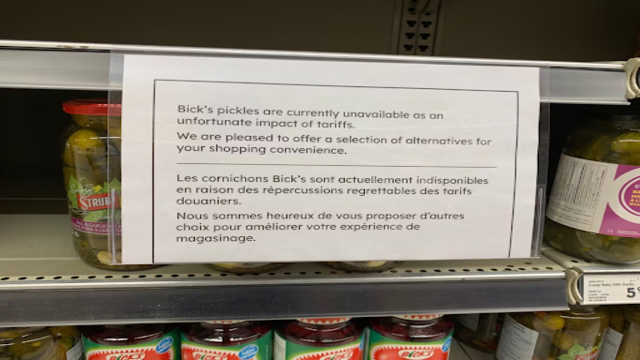
At an Edmonton Safeway, a shelf sign informed shoppers that Bick’s pickles are out of stock, citing tariffs as the reason for the shortage. CBC
Bick’s pickles, a well-loved staple in many Canadian households, have vanished from some store shelves. The reason? A trade dispute between Canada and the United States has made the cost of bringing the product into Canada much higher.
Shoppers in some Edmonton Safeway locations recently noticed a sign explaining the absence. It stated that Bick’s products were unavailable because of tariffs, with alternative brands now on offer. The parent company of Safeway did not provide a public comment.
Tariffs Drive Up Costs
TreeHouse Foods Inc., which owns the Bick’s brand, says the problem began when the U.S. added tariffs to Canadian goods earlier this year. Canada responded with its own measures, including a 25% tariff on cucumbers and gherkins.
TreeHouse Foods CEO Steven Oakland says the extra cost makes it hard for retailers to stock the pickles. He explains that in the food business, small profit margins leave little room to absorb such a steep increase.
Impact on Supply and Jobs
Bick’s still appears in about 70% of Canadian stores, but sales have dropped 25% in the past three months. Oakland says the company will buy fewer cucumbers and jar lids from Canadian suppliers if sales remain low.
Although Bick’s production moved to Wisconsin in 2014, the company still buys 11 million pounds of cucumbers from Ontario each year and all jar lids from an Ontario supplier. This cross-border relationship has now become expensive due to the tariff war.
Canadian Farmers Could Feel the Pinch
Some experts warn that shoppers switching to Canadian-made pickles might not help as much as it seems. If people avoid Bick’s, the company will purchase fewer Canadian-grown cucumbers, which could hurt local farmers.
Economists note that in many cases, consumers ultimately pay the price through higher costs or fewer choices.
Shoppers React to the News
For some pickle lovers, the disappearance is personal. Edmonton resident Crystal Porcher admits to eating pickles at least twice a week and even has a pickle tattoo. She says she will keep buying them despite price hikes, but if Bick’s isn’t available, she will look for other brands.
Industry Push for Tariff Relief
Industry representatives want food products, including pickled vegetables, exempt from import duties under the Canada-United States-Mexico Agreement. They argue that the 25% import duty makes it nearly impossible to make a profit in such a competitive market.
Oakland says the timing is especially unfortunate as summer barbecue season begins—a peak time for pickle sales.