Bill C-12 could be a turning point in Canada’s Immigration Identity. Urbana News.
In a country where immigration has long been framed as a pillar of national identity, the introduction of Bill C-12 — the Strengthening Canada’s Immigration System and Borders Act — marks a decisive shift. The Canadian government insists the bill is a modern solution to a system under pressure. Critics say it is something far more consequential: the most sweeping expansion of border-enforcement powers in a generation.
But beyond the political rhetoric, the data tells a clearer story. Canada’s asylum numbers have surged, irregular crossings have fallen, and temporary resident volumes have reached historic highs. These trends form the landscape into which Bill C-12 has been introduced — where the consequences will be felt not only at airports and border checkpoints, but in classrooms, workplaces, refugee shelters, and community organizations across the country.
A System Under Strain: The Numbers Behind the Debate
Canada processed more than 144,000 asylum claims in 2023, a 56% increase over the previous year. Irregular crossings dropped from ~40,000 in 2022 to ~17,000 in 2023, largely due to the expanded Safe Third Country Agreement — but overall demand for asylum did not fall. The push simply moved from irregular routes to formal ports of entry.
At the same time, Canada admitted 74,979 refugees and protected persons as permanent residents — a modest rise of just 1%. Resettled refugee admissions stood at 51,081, reaffirming Canada’s long-standing humanitarian commitments but also exposing the limits of processing capacity.
These numbers reflect a system facing both pressure and contradiction: rising need, constrained pathways, and large backlogs that persist despite declining irregular crossings.
Into this mix, the parliament introduced Bill C-12, the American-style refugee and border policies to Canada, resurrecting a discriminatory and anti-migrant approach to immigration that we have not seen since the early 20th century.
What Bill C-12 Actually Proposes
Bill C-12 bundles together strengthened enforcement, broader screening abilities, and new administrative powers. According to government summaries and departmental briefings, the bill would:
- allow authorities to cancel or suspend visa, permit, or immigration applications
- expand CBSA’s authority to detain or seize suspicious shipments
- expanded cross-agency information-sharing between immigration, security, and border agencies
- introduce more structured tools to investigate organized migration fraud and trafficking
- the ability to restrict or fast-track certain classes of applicants during “extraordinary circumstances.”
Supporters argue these powers will help Canada manage high asylum volumes while maintaining border integrity.
However, critics warn that the bill grants the government near-unilateral power to block entry, slow humanitarian pathways, and reshape immigration based on political priorities rather than due process.
Who May Feel the Impact First
1. Refugees and Asylum Seekers
Refugee advocates warn that expanded cancellation powers could make asylum protection more fragile. With 144,000+ claims in a single year, even small administrative shifts can have wide consequences.
C-12 could:
- introduce new pre-screening barriers
- expand ineligibility rules
- give officers broader discretion to fast-track rejections
- slow processing during reviews or suspensions
For people fleeing persecution — including political dissidents, religious minorities, and LGBTQIA+ refugees — these shifts could make their safety more uncertain.
Canada’s refugee protection system, historically considered robust, may face new limits on access even before a case reaches the IRB.
2. International Students
Canada hosts over 900,000 international students, many of whom contribute billions to the economy.
Under C-12, student visa applications — already facing scrutiny due to fraud concerns — could see:
- higher cancellation rates
- more extensive document verification
- broader investigations into third-party intermediaries
Students from high-risk regions may face disproportionate obstacles. Universities warn that unpredictable visa outcomes could undermine enrollment, revenue stability, and Canada’s global competitiveness.
3. Temporary Foreign Workers
With Canada’s labor market increasingly dependent on foreign workers — from agriculture to healthcare — C-12’s enforcement measures may intersect with the Temporary Foreign Worker Program (TFWP).
Possible impacts include:
- delayed work permits during fraud reviews
- stricter employer verification processes
- increased vulnerability for migrant workers if applications can be suspended mid-employment
Labor groups caution that workers already at risk of exploitation may become even more hesitant to report abuse.
4. Visitors and Family Members
Visitor visa refusal rates for some countries already exceed 50%. C-12’s expanded cancellation and data-matching tools could push rejection rates higher, especially for applicants from regions flagged for fraud risk.
Family reunification — a core pillar of Canadian immigration — may also see greater scrutiny under enhanced verification rules.
5. LGBTQIA+ Applicants
LGBTQIA+ migrants, refugees, and asylum seekers face unique vulnerabilities.
Advocacy groups worry that:
- broad cancellation powers may disproportionately affect applicants with non-traditional documentation
- rushed pre-screening could overlook gender-based persecution
- detention or extended reviews could expose queer asylum seekers to unsafe environments
For communities fleeing criminalization or violence abroad, delays or suspensions can have life-altering consequences.
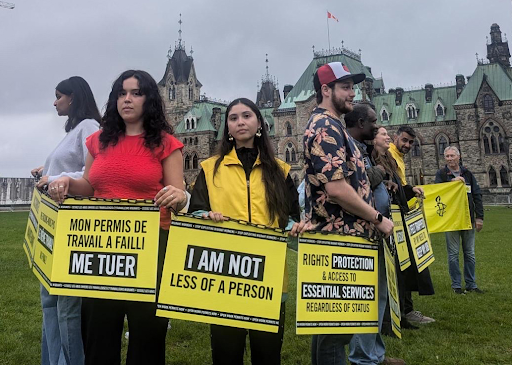
Human rights advocates rally on Parliament Hill in Ottawa to kick off the 2025 National Days of Action for Migrant Workers' Rights. Photo Credit: Amnesty International
Canada’s Refugee Tradition at a Crossroads
For decades, Canada positioned itself as a humanitarian leader with one of the world’s most respected refugee systems.
C-12 could alter that identity.
While the government says the bill strengthens the system, experts argue it effectively weakens access to that very protection by turning administrative discretion into a central filtering tool.
Several analysts note that if C-12’s powers are used aggressively, the bill could function less as a modernization measure and more as a gatekeeping mechanism — one that shifts Canada closer to a deterrence-based model historically associated with other Western nations.
Economic Implications: A Risk to Labour and Growth
Immigration accounts for virtually all of Canada’s labor-force growth. With an aging population and low birth rates, the country cannot sustain economic momentum without steady inflows of workers, students, and permanent residents.
C-12 introduces several uncertainties:
- visa cancellations could disrupt labour pipelines
- delays could slow sectors already struggling with shortages
- restrictions may discourage skilled immigrants who have global mobility
- the education sector — worth billions annually — may experience revenue losses
Economists warn that if implementation is overly restrictive, the bill may unintentionally tighten Canada’s labor market at a time when it can least afford to.
Why Experts Call It a “Dark Chapter”
Legal scholars, refugee advocates, former immigration officers, and civil liberties groups have described Bill C-12 as:
- “a dangerous moment for Canadian immigration policy”
- “a structural rollback of humanitarian access”
- “a shift toward securitized migration management”
- “the most regressive legislation since the post-9/11 era”
The criticism centres on three themes:
- Unprecedented discretionary power
Officers and ministers could suspend or cancel large categories of applications without public transparency. - Weak procedural safeguards
Applicants may have fewer avenues to challenge rejections or delays. - Potential for discriminatory outcomes
Broad screening tools risk disproportionately affecting racialized, queer, and low-income migrants.
For many experts, C-12 represents not only a policy shift but a philosophical one — moving Canada from a humanitarian model to a security-first model of migration governance.
A New Era of Canada’s Security—Or a Return to Old Patterns?
Bill C-12 seeks to respond to many pressures — but in doing so, it may redefine who Canada lets in, how people are screened, and how refugee protection operates in practice.
The bill’s portrayal of migration as a “border security” threat—and the political rhetoric casting immigrants as risks—echoes Canada’s historic “none is too many” stance.
What is most striking is the irony: a law framed as protection may ultimately erode the security of those who sought refuge here. By enabling routine infringements of Charter rights and international protections for anyone without citizenship, Bill C-12 opens the door to practices long condemned in the United States—family separations, accelerated deportations, and widespread due-process failures.
Whether C-12 becomes a tool for modernization or a symbol of retrenchment will depend on how its powers are wielded. For now, critics warn that the bill pushes Canada toward a more restrictive, less predictable system — one that may be remembered as a turning point, and possibly, a dark chapter in the country’s immigration story.