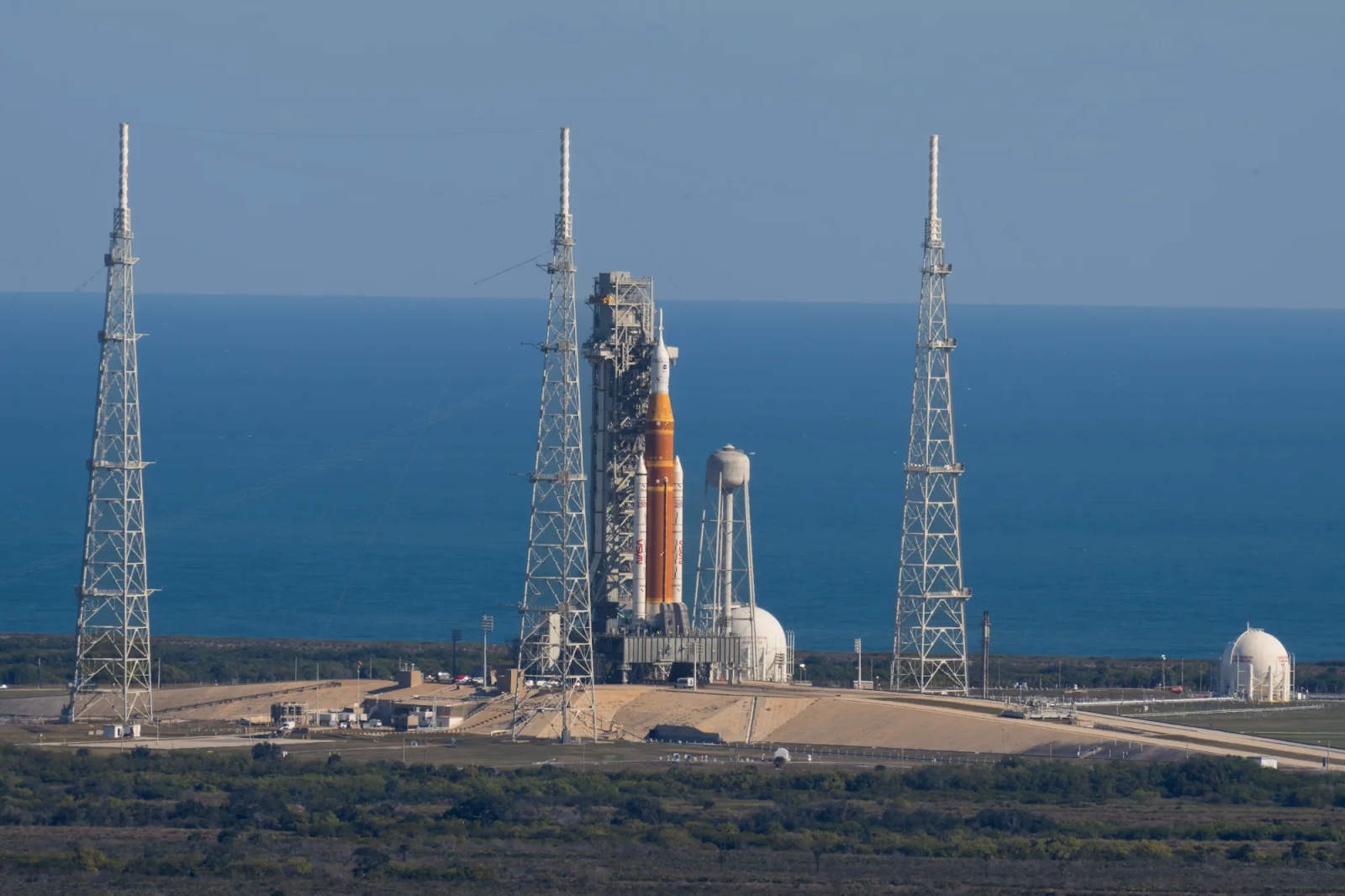
The LIGO Hanford Observatory features two arms, each stretching four kilometres in length. Image: MIT
Space just rang like a cosmic tuning fork. Scientists have captured the loud “ringing” from two black holes colliding, confirming theories by both Albert Einstein and Stephen Hawking.
A Cosmic Symphony
The discovery came from the Laser Interferometer Gravitational-Wave Observatory (LIGO) in the U.S., which detects ripples in space-time known as gravitational waves. These waves occur when massive objects, like black holes, collide in energetic cosmic events.
This particular wave, named GW250114, originated 1.3 billion light-years from Earth. The collision involved two black holes, each about 30 times the mass of our Sun, merging into a single larger black hole.
While LIGO has recorded nearly 300 such events before, this one revealed something extraordinary.
The “Ringing” of Black Holes
The merger produced a “ringing” — vibrations that emitted two distinct tones. These tones act like a black hole’s fingerprint, confirming predictions made decades ago.
Jess McIver, associate professor at the University of British Columbia, explained, “It’s like hitting a tuning fork. The black hole vibrates at certain frequencies, and this signal was loud enough to measure them clearly.”
Max Isi, assistant professor at Columbia University, added, “There’s a fundamental tone and an overtone. Matching tones confirm that mass and spin alone define a black hole.”
This proves Roy Kerr’s 1963 prediction about spinning black holes and also reinforces Einstein’s general relativity, which foretold the existence of black holes.
Hawking’s Theorem Confirmed
The collision also validated Stephen Hawking’s area theorem. The theorem predicts that when two black holes merge, their combined event horizon — the surface beyond which nothing can escape — can only grow.
Before merging, each black hole had a surface area of roughly 240,000 square kilometers. Afterward, the new black hole measured 400,000 square kilometers. Hawking’s theory holds true.
Interestingly, while the surface area increased, the total mass slightly decreased. Some energy was released as gravitational waves, in line with the famous equation E=MC². The resulting black hole weighed 63 times the Sun, slightly less than the sum of the originals.
Why This Detection Matters
Earlier gravitational wave events, like the first detected in 2015, provided hints but not definitive proof. This recent collision produced a signal four times stronger, offering clear, undeniable evidence of these cosmic principles.
The 2015 detection already earned a Nobel Prize in Physics, marking the beginning of a new era in understanding space-time. Today, collaborations like LIGO-VIRGO-KAGRA include observatories around the globe, improving sensitivity to these cosmic events.
A Glimpse into the Future
Scientists are excited about what stronger and more precise detectors will reveal. McIver said, “Every time we analyze this data, Einstein, Kerr, and Hawking are confirmed. But with future improvements, we might discover something entirely unexpected.”
This black hole merger isn’t just a scientific milestone; it’s a moment where the universe spoke, and humanity finally heard. The cosmos, it seems, has a rhythm, and we are beginning to understand its tune.