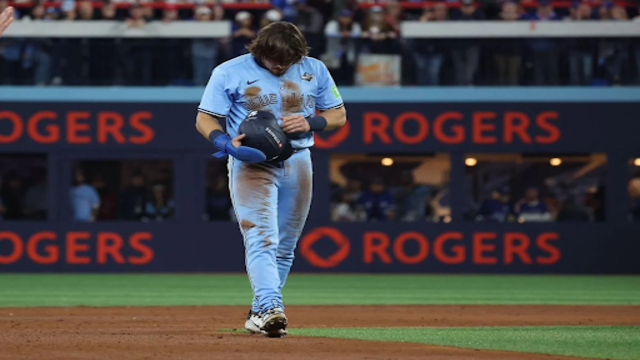
Addison Barger was dejected after he was double-off at second base to end a wild last inning in Game 6. TSN
The Rogers Centre was electric. The Toronto Blue Jays seemed destined for another storybook ending — until chaos struck. What started as a thrilling comeback attempt in the ninth inning ended in disbelief, confusion, and heartbreak for the home crowd as the Dodgers held on for a 3-1 win in Game 6 of the World Series. The dramatic loss forced a decisive Game 7.
A Stadium Full of Hope
The Blue Jays entered the ninth inning trailing 3-1. The noise inside the Rogers Centre was deafening, with fans chanting, clapping, and singing along to “Who Let the Dogs Out.” Toronto needed magic against Dodgers closer Rōki Sasaki — a pitcher who had given up only one run throughout the playoffs.
The energy was contagious. Every fan believed a comeback was possible.
Barger Sparks the Crowd
Addison Barger gave the crowd something to roar about. With a 2-2 count, he crushed a fastball deep into the left-center gap. As Barger and Will Straw raced around the bases, Dodgers outfielders Justin Dean and Kiké Hernández stopped chasing the ball. Dean raised his hands, signaling to the umpires that the ball had lodged beneath the outfield padding.
Fans thought they were witnessing a two-run, game-tying inside-the-park home run. Barger crossed home plate, and the Rogers Centre erupted. But moments later, confusion set in. The umpires ruled it a dead ball, awarding Barger an automatic double and sending the runners back to second and third.
The decision stunned the crowd. Blue Jays manager John Schneider challenged the ruling, but the replay confirmed the call.
Under Major League Baseball rules, a ball stuck under the wall padding automatically becomes a ground-rule double — even if it looks retrievable. The umpire has no discretion on runner placement.
What felt like destiny suddenly turned into despair.
Enter Glasnow: Dodgers’ Season on the Line
With runners on second and third and no outs, the Dodgers turned to Tyler Glasnow — their Game 3 starter and projected pitcher for Game 7. His mission was clear: keep the Dodgers’ championship hopes alive.
On his first pitch, he forced Ernie Clement into a quick pop-out. One out, two runners stranded.
The tension in the stadium grew thicker.
A Costly Misread
Next up was Andrés Giménez, Toronto’s reliable ninth hitter. He’d been clutch all postseason, driving in 11 runs in 16 games.
Glasnow threw a breaking ball high, then followed with a pitch Giménez lifted into shallow left field. Barger took off from second, convinced it would drop in.
“I was being too aggressive,” Barger admitted later. “I thought it would get over the shortstop’s head. It was just a bad read.”
Instead, Hernández charged forward, made the catch, and fired to second base. Barger, caught halfway between bases, couldn’t get back in time. The result — a 7-4 double play to end the game.
It was the first time in MLB playoff history that a game ended on a 7-4 double play.
From Euphoria to Silence
As the replay flashed on the big screen, fans held their breath, hoping for a reversal. But when the umpires confirmed the call, the mood shifted instantly. The once-roaring Rogers Centre fell silent.
The Dodgers celebrated on the field. The Jays trudged off, knowing how close they came to rewriting history.
What could have been a thrilling comeback turned into a lesson in how fast baseball’s fortunes can flip.
Game 7 Awaits
Despite the heartbreak, Toronto isn’t done. Game 7 offers redemption — one last chance to turn heartbreak into triumph.
The Blue Jays have shown resilience all season. Their fans, though shaken, will return with hope. And after Friday’s chaotic finish, one thing is certain — Game 7 will be unforgettable.