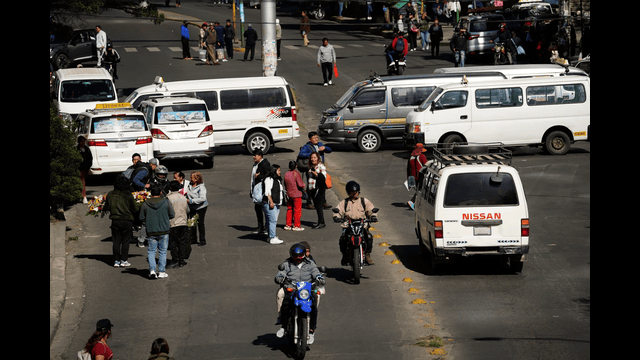
People walk during a strike by the public transport sector, Friday 19, December 2025.
Bolivia’s biggest cities ground to a halt on Friday as a transportation strike erupted over a sharp fuel price hike. Public transport workers protested a 100% increase in fuel prices ordered by the country’s new government, triggering widespread disruption and public anger.
Major Cities Shut Down by Strike
In La Paz and Santa Cruz, streets fell silent as buses and minibuses stopped operating. Protesters blocked intersections and highways, bringing daily life to a standstill.
Long queues formed at fuel stations and markets. Many residents joined marches, fearing further price increases in the coming days.
Rising Prices Fuel Public Anger
The fuel price hike immediately pushed transportation fares higher. Food prices surged alongside them, adding pressure on household budgets.
“Transportation fares doubled overnight,” said homemaker Natalia Rodríguez. “Food prices are already through the roof and rising again.”
Shoppers rushed to markets to stock essentials before costs climbed further.
Unions Warn of Nationwide Protests
Transportation unions warned that protests could spread across the country. They demand the government restore gasoline and diesel subsidies.
“The government has given the people the worst Christmas gift,” said Edson Valdez, a union leader. “If nothing changes, protests will expand nationwide.”
Union leaders insist drivers cannot absorb fuel costs without raising fares further.
Government Defends Fuel Price Increase
Officials defended the decision as unavoidable. Government spokesman Lupo called the measure painful but necessary.
“It is a painful measure, but it must be done,” he said. “There is no other way.”
The government delegated negotiations over urban fares to local mayors, asking cities to manage transport disputes independently.
New President Blames Economic Crisis
President Rodrigo Paz, who took office just over a month ago, blamed years of mismanagement for the crisis. His election ended two decades of leftist rule in Bolivia.
“We inherited a country hurt economically,” Paz said. “There are no dollars, high inflation, fuel shortages, and empty reserves.”
He described the fuel subsidy cuts as the end of a “populist cycle” marked by waste and corruption.
Inflation and Deficit Drive Reforms
Bolivia’s inflation rate is expected to reach 22% by year-end. The fiscal deficit stands at 12.5% of GDP, according to the Ministry of Economy.
Officials say ending fuel subsidies will save $3 billion, which will be redirected toward investments and economic stabilization.
Fuel Imports Drain Foreign Reserves
Bolivia imports half of its gasoline and nearly all its diesel. For years, fuel was sold domestically at half price.
That policy drained foreign currency reserves and caused fuel shortages. These shortages hurt food production and pushed prices higher nationwide.
Mixed Reaction to Broader Economic Plan
Despite protests, Paz’s broader reforms have drawn support. His package includes a 20% wage increase and continued social bonuses for poorer households.
Business leaders welcomed the plan. The U.S. government also voiced support for Bolivia’s economic direction.
International Support Begins
A delegation of U.S. business leaders met President Paz this week to discuss investment opportunities.
Meanwhile, Bolivia’s Legislative Assembly approved a $550 million loan from the Andean Development Corporation, known as CAF. The funds aim to stabilize the economy and reduce debt.
Uncertain Days Ahead
As negotiations stall, uncertainty looms. Transportation workers remain firm, while the government insists reforms must continue.
Whether Bolivia can balance economic recovery with social stability now depends on dialogue, compromise, and swift action in the days ahead.