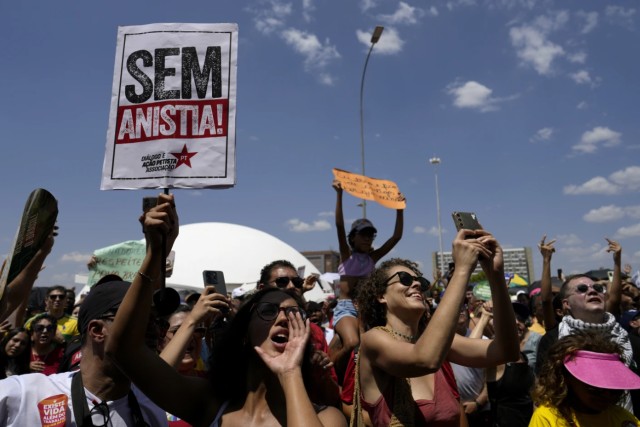
Demonstrators protest an amnesty bill that could benefit former President Jair Bolsonaro and his allies convicted for a 2023 coup attempt, in Brasilia, Brazil, Sunday, Sept. 21, 2025.
Thousands of Brazilians took to the streets on Sunday to protest a bill that could pardon former President Jair Bolsonaro and his allies. The demonstrations occurred across all 26 states and the federal district, fueled by growing concerns over Brazil’s democratic process.
The protests follow a series of legislative moves that critics say could weaken accountability. On Tuesday, the lower house passed a constitutional amendment making it harder to arrest or prosecute lawmakers. The measure now moves to the Senate for approval.
The next day, lawmakers fast-tracked a bill backed by right-wing opposition members. This legislation could grant amnesty to Bolsonaro, his closest allies, and hundreds of supporters convicted for their involvement in the January 2023 uprising.
Mass Mobilization in Major Cities
In São Paulo, approximately 42,400 people joined the protest, while 41,800 demonstrated in Rio de Janeiro, according to estimates from the University of São Paulo’s Monitor of Political Debate and the nonprofit More in Common. Drone images helped researchers calculate crowd sizes.
Pablo Ortellado, director of the Monitor of Political Debate, noted that turnout in Brazil’s two largest cities marked the largest left-wing demonstrations since President Luiz Inácio Lula da Silva’s 2022 election victory. He also highlighted a shift in political mobilization.
“Right-wing demonstrations have typically been three times larger than those of the left,” Ortellado said. “But in recent months, opposition to Trump-inspired tariffs and the amendment has brought leftist groups back into the streets.”
Bolsonaro’s Conviction and Public Response
Bolsonaro was sentenced to 27 years and three months in prison on September 11 for attempting to remain in power after losing the 2022 election. He is the first former president in Latin America’s largest economy to be convicted of trying to overturn an election. Bolsonaro denies any wrongdoing.
Among the protesters was Ana Paula Brito, a 37-year-old nanny from São Paulo. She expressed outrage not only at the possible pardon but also at the proposed amendment shielding lawmakers.
“They are rich, have plenty of money, and keep stealing,” Brito said. “No funds are released for ordinary citizens. That’s why we’re in the streets today.”
Artists and Cultural Icons Join the Movement
Sunday’s protests were amplified by prominent Brazilian artists. Music legends Caetano Veloso, Chico Buarque, and Gilberto Gil—icons who defied censorship during Brazil’s 1960s military dictatorship—led a demonstration in Rio de Janeiro’s Copacabana neighborhood.
Veloso told the news outlet UOL that he opposed both the shielding law for lawmakers and the proposed amnesty for Bolsonaro and his allies. “I identified with the majority of the Brazilian population, who do not want these measures to pass,” he said.
Actor Wagner Moura attended a protest in Salvador, Bahia. From a truck, he emphasized the significance of the moment for Brazilian democracy rather than the legislative details. “This extraordinary moment serves as an example to the entire world,” Moura declared.
Symbolism and Political Messaging
Left-wing groups used Sunday’s protests to counter right-wing demonstrations. Two weeks ago, Bolsonaro supporters displayed a giant U.S. flag in São Paulo, thanking former President Donald Trump for sanctions against Brazil. Trump had previously called Bolsonaro’s trial a “witch hunt” and linked tariffs on Brazilian goods to the former president’s fate.
In response, protesters unfurled a massive Brazilian flag, using posters, T-shirts, and stickers to reject amnesty and protections for lawmakers while affirming national pride and sovereignty.
Deep Political Divide in Brazil
Despite widespread protests, polls show Brazil remains deeply divided over Bolsonaro. A Datafolha survey released on September 16 found that 50% of respondents believe Bolsonaro should be jailed, while 43% disagreed. The poll interviewed 2,005 people nationwide and has a margin of error of 2 percentage points.
As Brazil faces a potential pardon for Bolsonaro and protective legislation for lawmakers, Sunday’s demonstrations signal that citizens remain highly engaged in defending democratic accountability and national sovereignty.