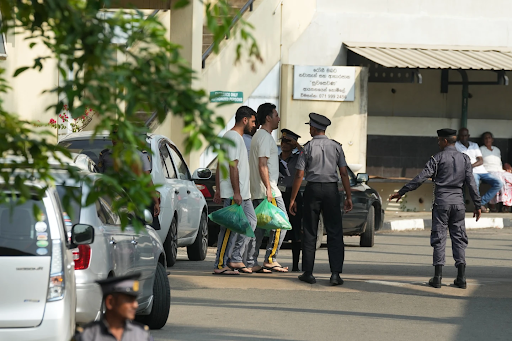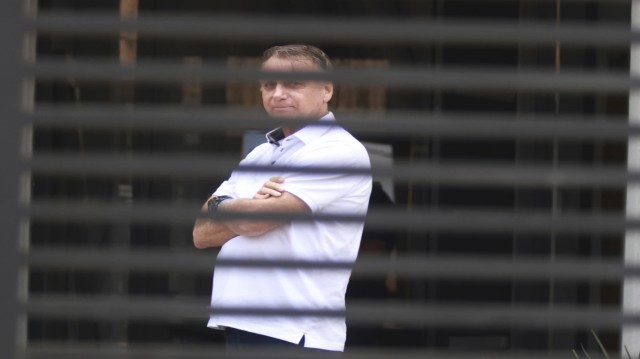
Brazil's former president Jair Bolsonaro stands outside of his home where he is under house arrest in Brasilia, Brazil, Tuesday, Sept2, 2025.
Former Brazilian President Jair Bolsonaro was sentenced to 27 years and three months in prison. The Supreme Court convicted him on charges of attempting a coup. Yet, even with a conviction and declining health, Bolsonaro’s political influence in Brazil continues to loom large.
His lawyer said he was too unwell to attend the final hearings. But observers note that his absence does not diminish his presence in politics. Experts argue Bolsonaro remains a central figure in Brazil’s right-wing movement, despite his ineligibility and house arrest.
Anthropologist Isabela Kalil describes him as a new type of political figure in Brazil—unable to run for office, yet still shaping national politics.
A Deeply Divided Nation
Only days before his conviction, thousands of Bolsonaro supporters marched during Brazil’s Independence Day celebrations. They called him a hero, praising his movement as unstoppable. Many believe his ideals cannot be silenced by prison walls.
“Ideals are not killed, ideals are not arrested,” said Luiz Niemeyer, a 62-year-old businessman from Rio de Janeiro.
Polls confirm the divide. Nearly half of Brazilians want Bolsonaro imprisoned. The other half believes he should remain free. The debate reflects how deeply polarization runs in Brazilian society.
A Datafolha survey found 48% support jailing Bolsonaro, while 46% oppose it. Another poll by AtlasIntel revealed that in a hypothetical rematch of the 2022 election, Bolsonaro would tie with President Luiz Inácio Lula da Silva. Bolsonaro polled at 45.4%, while Lula secured 44.6%.
Despite legal troubles, Bolsonaro still commands the loyalty of millions. To challenge Lula in 2026, any opposition candidate will likely need his endorsement.
Not a Weakened Leader
Some argue Bolsonaro’s influence has only grown. The January 8 riots in 2023, when his supporters stormed public buildings, showcased his grip over the far right.
Kalil explained, “He still has a base and continues shaping the right. That’s not weakness.”
Pastor Silas Malafaia, one of Bolsonaro’s strongest allies, agrees. “He’s the greatest right-wing leader in Latin America,” he declared.
Supporters are even pushing for an amnesty bill in Congress. The measure would erase his sentence and restore his political rights, currently suspended until 2030.
Senator Ciro Nogueira openly called for Bolsonaro’s return. “Without him, we won’t win. He is the guiding figure,” he said.
Searching for a Successor
Still, Brazil’s right-wing leaders are quietly preparing alternatives. Names like São Paulo Governor Tarcísio de Freitas and Paraná Governor Ratinho Junior have emerged as possible successors. Bolsonaro’s eldest son, Senator Flávio Bolsonaro, is also floated as a contender.
De Freitas, a former minister under Bolsonaro, is seen as a strong option. As governor of Brazil’s wealthiest state, he commands influence and popularity. At a recent rally, he echoed Bolsonaro’s rhetoric, criticizing Supreme Court Justice Alexandre de Moraes.
After the conviction, De Freitas defended Bolsonaro on social media. “Stay strong, President. We will remain by your side,” he wrote.
Yet, Bolsonaro’s inner circle shows signs of distrust. Private messages revealed his son Eduardo accusing De Freitas of pursuing his own political ambitions. De Freitas, however, insists he would grant amnesty to Bolsonaro if elected in 2026.
Toward ‘Bolsonarism 2.0’
Bolsonaro’s conviction may mark not the end, but the evolution of his movement. Sociologist Esther Solano calls this next phase “Bolsonarism 2.0.”
She believes the ideology is no longer tied solely to Bolsonaro. Instead, it is expanding into a larger conservative movement with new leaders ready to step in. Figures like Michelle Bolsonaro, lawmaker Nikolas Ferreira, and evangelical pastors are rising in influence.
“Bolsonarism is consolidating,” Solano explained. “It is creating a new ecosystem of leaders who can thrive beyond Bolsonaro himself.”
Bolsonaro may be under house arrest and barred from elections. But his conviction has not silenced his movement. Instead, Brazil may be witnessing the birth of a new chapter in its politics—one where Bolsonaro remains a symbol, while others carry his torch forward.
His future in politics may be uncertain. His influence, however, is undeniable.