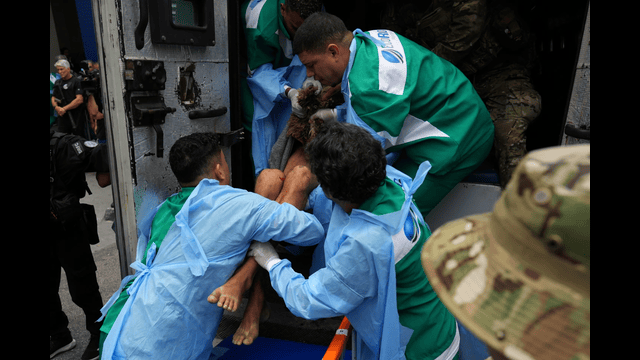
Getulio Vargas Hospital workers remove an injured person from a police truck after he was injured in a police operation against alleged drug traffickers in the Complexo do Alemao favela where the criminal organization “Comando Vermelho” operates in Rio de Janeiro, Tuesday, Oct. 28, 2025.
At least 64 people were killed and 81 arrested after one of Brazil’s largest-ever police operations struck a powerful drug-trafficking network in Rio de Janeiro on Tuesday. The massive raid targeted the Red Command gang, triggering hours of intense gunfire across two sprawling favelas.
Officials said 2,500 police officers and soldiers were deployed in the operation, which included helicopters and armored vehicles sweeping through the neighborhoods of Complexo do Alemão and Penha.
Brazil’s Biggest Police Operation in Years
Rio state’s governor, Cláudio Castro, described the action as the “largest and most successful” in the city’s history. He confirmed that 60 criminal suspects were neutralized, while 93 rifles and more than half a ton of drugs were seized.
Authorities said the gang members killed had “resisted police action.” However, the raid also claimed the lives of four police officers, sparking anger and grief across law enforcement.
Human Rights Groups Condemn the Violence
The United Nations Human Rights Office said it was “horrified” by the deadly scale of the operation and urged Brazil to conduct an independent investigation.
César Muñoz, Director of Human Rights Watch in Brazil, called it a “disaster” and demanded prosecutors clarify how each death occurred.
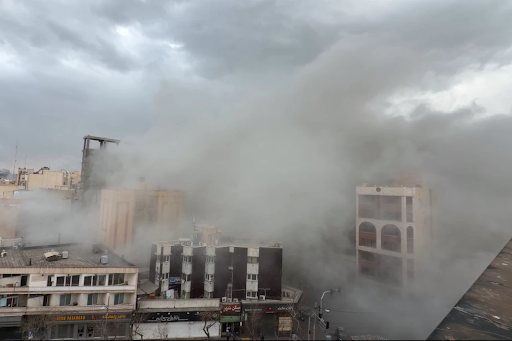
Footage circulating on social media showed smoke and fire filling the sky as gunshots echoed through the favelas.
Schools Shut, Roads Blocked Amid Chaos
The raid paralyzed parts of Rio de Janeiro. The city’s Education Department confirmed that 46 schools were forced to close, while the Federal University of Rio de Janeiro canceled night classes and told students to shelter in place.
In retaliation, suspected gang members blocked major roads in northern and southeastern Rio. According to Rio Ônibus, the city’s bus transport organization, at least 70 buses were hijacked and used to form barricades, causing widespread damage.
Political Tensions Rise After the Raid
The raid followed a year-long investigation into the Red Command’s criminal network.
Governor Castro, a member of Brazil’s Liberal Party, used the moment to criticize the federal government led by President Luiz Inácio Lula da Silva, arguing that “more federal support is needed to combat organized crime.”
Responding to the criticism, Gleisi Hoffmann, the government’s congressional liaison, pointed to recent crackdowns on money laundering as proof of federal action.
Following the deadly raid, Vice President Geraldo Alckmin and several cabinet ministers held emergency talks, while Chief of Staff Rui Costa called for a crisis meeting in Rio the next day.
Rio’s Long History of Violent Raids
The Red Command gang, originally formed in Rio’s prisons, has strengthened its grip over favelas in recent years.
Deadly police raids are not new to Rio. In 2005, 29 people were killed in Baixada Fluminense, and in 2021, 28 died in Jacarezinho during another major operation.
Despite the massive scale, experts warn such actions rarely lead to lasting change. Luis Flávio Sapori, a sociologist and public safety expert, said these raids often eliminate low-level members while leaders remain untouched.
“It’s not enough to go in, exchange gunfire, and leave,” Sapori said. “Rio needs a long-term security strategy, not short bursts of violence.”
Calls for Accountability and Change
The Marielle Franco Institute, a nonprofit advocating for residents of Rio’s favelas, condemned the raid as “a policy of extermination.”
“This is not public safety,” the group said in a statement. “It’s a policy that turns the lives of poor and Black communities into a daily gamble.”
As Brazil mourns another bloody chapter in Rio’s battle against gangs, global attention is turning to how the country balances security enforcement and human rights — a question that remains painfully unresolved.