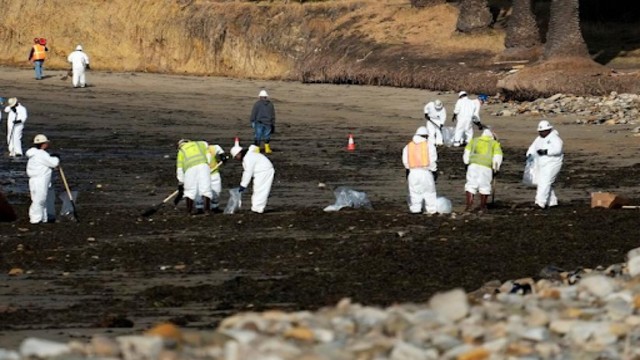
When the corroded pipeline burst in 2015, inky crude spread along the Southern California coast, becoming the state’s worst oil spill in decades. Clean-up crews removing oil-laden sand. North of Goleta, Calif., May 20, 2015. AP Photo
California’s coast could soon see a return of offshore oil drilling, despite past environmental disasters and mounting legal battles. Sable Offshore Corp., a Texas-based energy company, is pushing to restart operations off Southern California, backed by federal officials from the Trump administration.
The company’s efforts have reignited debates over energy production, environmental safety, and state versus federal control.
The Legacy of a Devastating Spill
The area’s history casts a long shadow. In 2015, a corroded pipeline released more than 140,000 gallons of crude oil along 150 miles of Southern California coastline. Beaches were blackened from Santa Barbara to Los Angeles. Endangered whales, sea turtles, and hundreds of birds and marine mammals perished. The fishing industry also suffered severe losses.
Plains All American Pipeline later agreed to a $230 million settlement with fishers and property owners but admitted no liability. Federal inspectors found the company’s response slow and ineffective. Three decades-old drilling platforms were subsequently closed.
Trump Administration’s Energy Push
Sable purchased the shuttered operation from Exxon Mobil in 2024 and aims to resume production. The company argues it can do so safely, restricting drilling to federal waters where California’s authority is limited. The state controls only the three miles closest to shore; Sable’s platforms lie five to nine miles offshore.
The Trump administration has endorsed the project, framing it as a step to boost domestic energy production. President Donald Trump directed Interior Secretary Doug Burgum to reverse prior restrictions on offshore drilling on both coasts.
“The president’s vision is American energy from American resources,” said Kenny Stevens, deputy director of the Bureau of Safety and Environmental Enforcement. The agency added that modern technology and continuous monitoring greatly reduce spill risks.
Legal and Environmental Opposition
Environmental groups and local authorities are fighting back. The Environmental Defense Center, based in Santa Barbara, sued Sable, warning the project risks another disaster amid declining oil demand and the worsening climate crisis.
Actor Julia Louis-Dreyfus, who lives locally, also protested the project, calling it untrustworthy. The California Coastal Commission fined Sable $18 million for ignoring cease-and-desist orders related to unpermitted repairs. A judge later ordered the company to halt operations pending legal review.
Sable also faces a lawsuit from the California Attorney General’s office for illegal waste discharge and failure to obtain necessary permits. The Santa Barbara District Attorney filed felony criminal charges, citing environmental harm. Sable maintains it has cooperated with state agencies, claiming no wildlife was harmed and denying wrongdoing.
Plans to Resume Operations
Despite the challenges, Sable remains determined. The company seeks $347 million for delays and is exploring options to operate entirely in federal waters using tankers if state restrictions persist. CEO Jim Flores said the project could stabilize California’s high gas prices, noting the state has recently lost refinery capacity.
On May 19, marking the 10th anniversary of the 2015 spill, Flores announced the first production tests at the Santa Ynez Unit. State officials countered that these were preliminary tests, not commercial production, prompting investor lawsuits.
The Bigger Picture
California has been gradually shifting toward clean energy, phasing out fossil fuel production, with Santa Barbara County leading local efforts. Sable’s push represents a sharp contrast to that vision, highlighting the tension between economic interests, energy needs, and environmental protection.
Federal authorities argue the region holds an estimated 190 million barrels of recoverable oil, nearly 80% of residual Pacific reserves. They insist advances in pipeline safety make drilling safer than in the past.
As Sable navigates court challenges and regulatory scrutiny, California officials, environmentalists, and residents remain vigilant, questioning whether the coast can safely accommodate renewed offshore drilling. The coming months will determine whether federal support will overcome state opposition — and whether California’s coastline will once again host risky fossil fuel extraction.