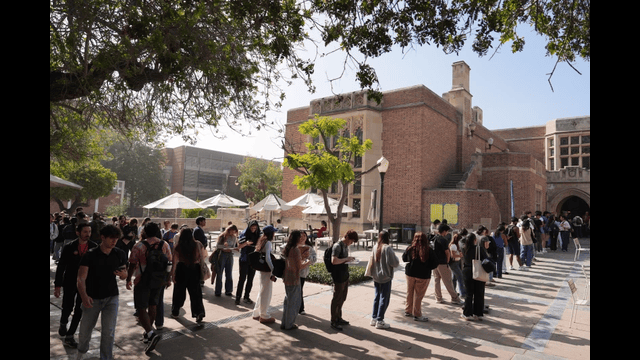
Voters form a line at a polling station on the UCLA campus Tuesday, Nov. 4, 2025, in Los Angeles.
California has redrawn the battle lines for control of the U.S. House. In a landmark decision, voters approved Proposition 50, a redistricting measure set to reshape California’s congressional map — and potentially reshape national politics. The move gives Democrats a major edge heading into the 2026 elections, countering similar Republican maneuvers in Texas and other GOP-led states.
A Victory for Democrats — and for Newsom
The approval of Proposition 50 marks a political win for Governor Gavin Newsom and a key moment in the national redistricting war. Backed by former President Barack Obama, Newsom cast the measure as a fight to protect democracy and resist former President Donald Trump’s influence.
“Republicans want to steal enough seats to rig the next election,” Obama said in one campaign ad, urging Californians to vote yes.
With this measure, Democrats could gain up to five additional U.S. House seats, just enough to offset the five-seat advantage Texas Republicans are pursuing under Trump’s guidance.
What Proposition 50 Does
Proposition 50 suspends California’s independent redistricting commission and replaces it with maps drawn by the Democratic-controlled Legislature. These maps will be used for the 2026, 2028, and 2030 elections.
Supporters argue the move is necessary to counteract Republican gerrymandering across red states. Critics, however, call it a blatant power grab that undermines the state’s independent redistricting system, established by voters in 2008 and 2010.
Schwarzenegger and Critics Push Back
Opposition came from prominent figures, including former Republican Governor Arnold Schwarzenegger, who helped create California’s independent redistricting commission.
“It makes no sense to fight Trump by becoming him,” Schwarzenegger said, warning that Proposition 50 would “take the power away from the people.”
Many conservative voters echoed his concerns. “I don’t want Newsom to have control,” said Rebecca Fleshman, a retired medical assistant from Norco. “I want the state to be red, not blue.”
A Costly Campaign Battle
The fight over Proposition 50 sparked one of the most expensive ballot campaigns in California’s history. Supporters, led by Newsom’s political machine, dominated the airwaves with over $5 million in TV, cable, and radio ads.
Opponents struggled to raise funds, especially in California’s high-cost media markets. By election day, total spending topped $100 million, with more than two-thirds coming from Proposition 50 supporters.
Republican lawmakers whose districts are set to be reshaped — including Reps. Ken Calvert, Darrell Issa, Kevin Kiley, David Valadao, and Doug LaMalfa — largely stayed quiet during the campaign. Most of them now face tougher odds as their districts gain more left-leaning voters.
“I’m not going anywhere,” Issa said defiantly after the vote. “I’ll continue to represent Californians regardless of their party.”
Voters Motivated by Party Control
According to an AP Voter Poll, around 70% of California voters said that party control of Congress was “very important” to them. Among those voters, support for Proposition 50 was overwhelming.
Eight in ten backers said they voted yes primarily to counter Republican redistricting efforts in other states. Only two in ten said they supported the measure because they believed it was the best approach to map drawing.
Trump’s Reaction and National Implications
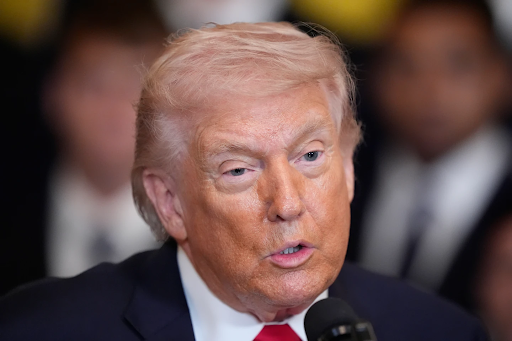
Former President Donald Trump, who lost California in all three of his presidential runs, largely stayed out of the campaign. However, he labeled the state’s voting process “rigged” in a social media post on election night, claiming it was under “serious legal and criminal review.”
California Secretary of State Shirley Weber dismissed Trump’s remarks as “another baseless claim.”
Redistricting Wars Spread Nationwide
California’s new House map has intensified the national redistricting battle. Democrats hope to offset GOP gains not only in Texas but also in states like Missouri, North Carolina, and Ohio, where Republicans expect to pick up several seats.
Five other Republican-led states — Florida, Indiana, Kansas, Louisiana, and Nebraska — are also weighing new maps. On the Democratic side, Colorado, Illinois, Maryland, New York, and Virginia have similar proposals, though many face legal or political hurdles.
“Fighting Fire With Fire”
For some new voters, Proposition 50 represented a symbolic stand.
Siddhartha Deb, who became a U.S. citizen the same day he voted, said supporting the measure was his way of defending democracy.
“I don’t like the way Republicans are rigging elections by gerrymandering,” he said. “This is the only way — to fight fire with fire.”
The Road to 2026
With California’s Proposition 50 approved, the battle for the 2026 U.S. House elections is already heating up. Democrats are celebrating a major strategic win, while Republicans are regrouping for what promises to be a fierce national fight over who controls Congress — and the direction of the country.