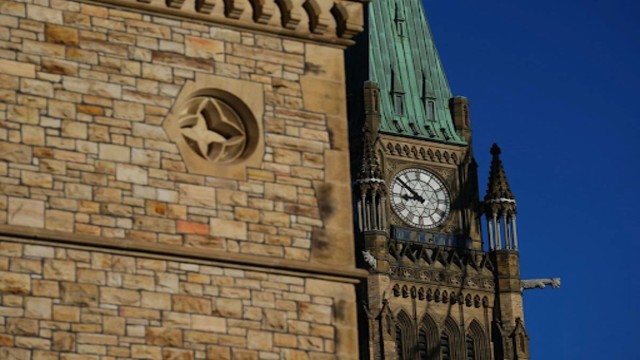
The Peace Tower is seen on Parliament Hill in Ottawa on Tuesday, Nov. 4, 2025. (The Canadian Press)
Artificial intelligence is reshaping Canada’s creative landscape, and many artists say it is happening too fast. The concern intensified after two AI-generated performers quietly climbed the Billboard charts this month. One was Xania Monet, whose debut placed her on the Adult R&B Billboard chart. The other was Breaking Rust, whose track topped the country digital song sales chart.
Both acts sounded human. Neither actually is.
For many creators, the moment signals a turning point. And not a reassuring one.
Rising Fears as AI Artists Hit Mainstream Platforms
The music community is sounding alarms.
Arun Chaturvedi, president of the Songwriters’ Association of Canada, says fear and frustration are spreading quickly.
He notes that human musicians already compete with roughly 100,000 new songs uploaded to streaming services each day. AI-generated music adds another wave.
Artists worry these new creations, sometimes dismissed as “AI slop,” could bury human talent even deeper.
Creative Sectors Warn MPs About Rapidly Growing Threat
The anxiety stretches far beyond music.
Federal MPs on the House of Commons Heritage committee recently held hearings on AI’s impact across the creative sector. Representatives from publishing, film, television, and music testified that AI relies on massive datasets built from copyrighted work — often without permission.
These industries argue that AI companies should not freely extract value from their creations. They want a transparent licensing system that tracks how copyrighted material is being used during AI training.
AI-Generated Books Now Compete With Real Authors
The book world is facing its own AI flood.
John Illingworth of the Association of Canadian Publishers told MPs that a “deluge” of low-quality AI-generated books now appears on major retail platforms.
He offered an example.
A search for “Mark Carney biography” on Amazon shows several AI-created titles with artificial cover art. Some rank higher than the former central banker’s real book.
Illingworth said readers often cannot identify the difference until they purchase the title — and discover it is incoherent.
Writers Claim AI Is Built on Their Labour
Representatives for writers echoed the same message.
Victoria Shen of the Writers Guild of Canada argued that generative AI depends on material created by real artists and now threatens those same professionals.
Tania Kontoyanni of the Union des Artistes put it more sharply, saying creators may have “fed a beast” that is now poised to consume their livelihoods.
Predictions of an AI-Dominated Digital World
Some experts warn that the problem is only beginning.
Wyatt Tessari L’Allié of AI Governance and Safety Canada said platforms like Spotify and Google are already overflowing with AI-made content. He predicts that within a few years, more than 90% of content seen by Canadians online could be AI-generated.
Even major media giants are exploring the trend. The CEO of Disney recently suggested that Disney+ may eventually allow users to generate their own content.
Industry Groups Push for Transparency, Not a Ban
Creative organizations are not asking the government to restrict AI innovation. Instead, they want transparency.
Erin Finlay, legal counsel for Access Copyright, said creators must know when their work is used to train AI models. Without that information, they cannot decide whether or how to license their content.
The Canadian Media Producers Association also supports a licensing market that allows rights holders to negotiate with AI developers.
A Copyright Fight With Global Stakes
Copyright is now at the heart of the debate.
Courts in Canada and the United States are examining how existing copyright law applies to AI training.
Some tech groups want a new “text and data mining” exception added to Canada’s Copyright Act. Creative industries strongly oppose the idea, saying it would give AI companies an unfair advantage.
But experts like Michael Geist from the University of Ottawa caution that overly strict rules could push AI development out of Canada. He argues that the country must balance creator protections with global competitiveness.
As lawmakers weigh these conflicting demands, artists hope one outcome becomes clear: transparency and licensing must be part of Canada’s AI future.